









Cart: (0) Items

You have no items in your shopping cart.

  • Reducing Push Effort and Operator Fatigue in Fiberglass Hull Assembly Carts


    Company Overview

    A mid-sized recreational boat manufacturer produces fiberglass boats ranging from 18 to 32 feet. Throughout the facility, partially assembled components are staged and transported between lamination, fitting, and final assembly areas using medium-duty material carts.

    Each cart is moved repeatedly throughout the shift, often fully loaded with hardware kits, seating assemblies, and structural components.


    Business Challenge

    Over time, assembly teams began reporting increasing push effort and inconsistent maneuverability during routine cart movement.

    "We were getting tired a lot faster than we should have been. Starting the carts and turning them just took too much effort."

    The carts remained structurally intact and within rated load capacity. Nothing was failing mechanically.

    However, operators described difficulty initiating motion and increased resistance during directional changes. Some employees began partially loading carts to reduce strain, slowing material flow between stations and introducing workflow inefficiencies.

    The issue was not structural capacity. It was rolling efficiency under repetitive daily use.


    Existing Caster Configuration (Before)

    Rig:
    5x2"
    Kingpin & rigid combo
    Zinc-plated steel


    Wheel:
    Rubber on cast iron
    Crowned
    Roller


    What Was Really Happening

    A technical review of the mobility system identified that the ergonomic complaints were rooted in energy transfer behavior within the wheel assembly rather than structural inadequacy.


    1. Energy Loss in the Rubber Tread

    Rubber on cast iron provides cushioning, but under sustained medium-duty loads, the tread continuously deforms.

    Each start and directional transition required the operator to overcome this deformation before forward motion could stabilize. Instead of efficiently returning energy into motion, the tread absorbed it. Over repeated cycles throughout the shift, that energy loss translated directly into increased push force and cumulative fatigue.


    2. Crowned Contact Concentration

    The crowned wheel face concentrated load toward the center of the tread. During initiation and steering transitions, localized compression increased, amplifying rolling resistance at the exact moment operators needed smooth response.

    While crowned profiles can aid maneuverability in some applications, in this sustained ergonomic environment, they contributed to higher startup resistance.


    3. Bearing Support Without Efficiency Optimization

    Roller bearings supported radial load effectively and were structurally appropriate for the duty class.

    However, they did not reduce deformation-driven rolling resistance occurring within the tread material. The bearing was not failing—but it was not offsetting the inefficiencies generated at the floor interface.


    The system remained mechanically sound. It was simply inefficient for repetitive ergonomic use.


    Recommended Solution

    After reviewing load profiles, travel distance, movement frequency, and the ergonomic design priority, a revised configuration was recommended to reduce energy loss and improve rolling predictability while remaining within medium-duty constraints.


    Updated Caster Configuration

    Rig:
    5x2"
    Kingpinless & rigid combo
    Zinc-plated steel


    Wheel:
    Heavy-duty glass-filled nylon
    Crowned
    Pedestal ball


    Why This Solution Worked


    Reduced Tread Deformation Under Load

    Heavy-duty glass-filled nylon introduced a significantly more dimensionally stable rolling interface. With minimal tread compression, startup resistance decreased and energy transfer became more direct. Operators no longer had to overcome continuous elastic deformation during each push cycle.


    Improved Rolling Efficiency and Energy Return

    By minimizing energy absorption within the wheel, more applied force translated directly into forward movement. Repetitive travel between stations required less cumulative effort, addressing the core ergonomic complaint.


    More Consistent Steering Response

    The kingpinless & rigid combo configuration improved swivel stability under load. Combined with pedestal ball bearings, directional transitions became more predictable and required less corrective input.


    The system functioned as an integrated mobility assembly—rig stability, tread rigidity, and bearing efficiency working together to reduce strain.


    Results

    • Noticeable reduction in startup push effort
    • Improved maneuverability during directional changes
    • Reduced operator fatigue across full shifts
    • Restoration of full cart loading without workflow slowdown

    "It feels like the carts finally move when we push them instead of fighting us."


    Key Takeaway

    Ergonomic performance in medium-duty environments is governed by how efficiently the mobility system transfers energy—not simply by whether components meet load ratings. Tread deformation, bearing friction, and rig stability interact to determine real-world push effort.


    When operator fatigue becomes the primary pain point, evaluating the wheel’s material behavior within the full caster system is essential. Optimizing rigidity, bearing efficiency, and swivel stability together can significantly reduce cumulative strain without increasing capacity.


    How CasterDepot Can Help

    For over 45 years, CasterDepot has helped boat manufacturing operations engineer mobility solutions that perform under real-world conditions—not just on spec sheets.


    Next steps:
    Talk it through with your local CasterHead®
    Discuss pricing and lead time
    Request supporting documentation
    Test a sample in your application


    Contact us now at https://www.casterdepot.com/contact/ or call one of our CasterHead® at 888.907.9952

  • Preventing Equipment Failure in High-Heat Metal Fabrication Environments


    Company Overview

    A regional metal fabrication company produces welded steel frames and structural assemblies for industrial equipment manufacturers. Their production floor runs multiple fabrication cells, each using mobile weld tables and fixture carts that move between cutting, welding, grinding, and finishing stations throughout the day.

    These carts frequently operate near active welding zones and often transport components immediately after welding, while parts are still radiating significant heat.


    Business Challenge

    Frequent caster failures began interrupting workflow across multiple shifts. Wheels were degrading faster than expected, resulting in unplanned maintenance, increased rolling resistance, and safety concerns on the production floor.

    “The wheels just couldn’t handle the heat. We were replacing them far more often than we should have been.”

    Employees observed visible wheel distortion and mobility changes after repeated exposure to elevated temperatures near welding operations.

    The issue did not appear to be load-related.
    It was temperature-related.


    Existing Caster Configuration (Before)

    Rig:
    5x2"
    Kingpin & rigid combo
    Zinc-plated steel


    Wheel:
    Polyurethane on polypropylene
    Crowned
    Roller


    Observed Result:
    Visible tread distortion, flat spotting, and increased rolling resistance after repeated exposure to elevated temperatures.


    What Was Really Happening

    The original configuration satisfied structural load requirements for medium duty use. On paper, it met capacity expectations.

    However, high-heat applications prioritize temperature capability and tread performance stability at elevated temperatures as primary selection variables . In this environment, wheel material temperature resistance should have been the dominant decision driver.


    1. Thermal Softening of the Tread

    Polyurethane tread behavior changes as temperature increases. Repeated exposure to hot welded components and radiant heat pushed the tread outside its optimal hardness band.

    Under load and thermal dwell, deformation became less controlled. Over time, this produced:

    • Visible tread distortion
    • Increased rolling resistance
    • Flat spotting after stationary heat exposure


    2. Dimensional Instability of the Hub Core

    The polypropylene core contributed to reduced dimensional stability under sustained heat. In high-temperature environments, hub material performance is a documented evaluation factor.

    As heat cycles accumulated, both tread and core experienced progressive performance changes.


    3. Secondary Bearing Effects

    The roller bearing was appropriate for load capacity. However, bearings depend on consistent wheel geometry. As the wheel deformed, load distribution through the bearing changed.

    The bearing was reacting to instability—it was not the cause.


    The failure was driven by material compatibility with sustained thermal exposure, not weight or bearing selection.


    Recommended Solution

    The revised configuration prioritized temperature capability and structural stability under sustained heat cycles. Rather than optimizing for floor feel or maneuverability first, wheel material selection was anchored to elevated temperature resistance and dimensional stability.


    Updated Caster Configuration

    Rig:
    5x2"
    Kingpin & rigid combo
    Zinc-plated steel


    Wheel:
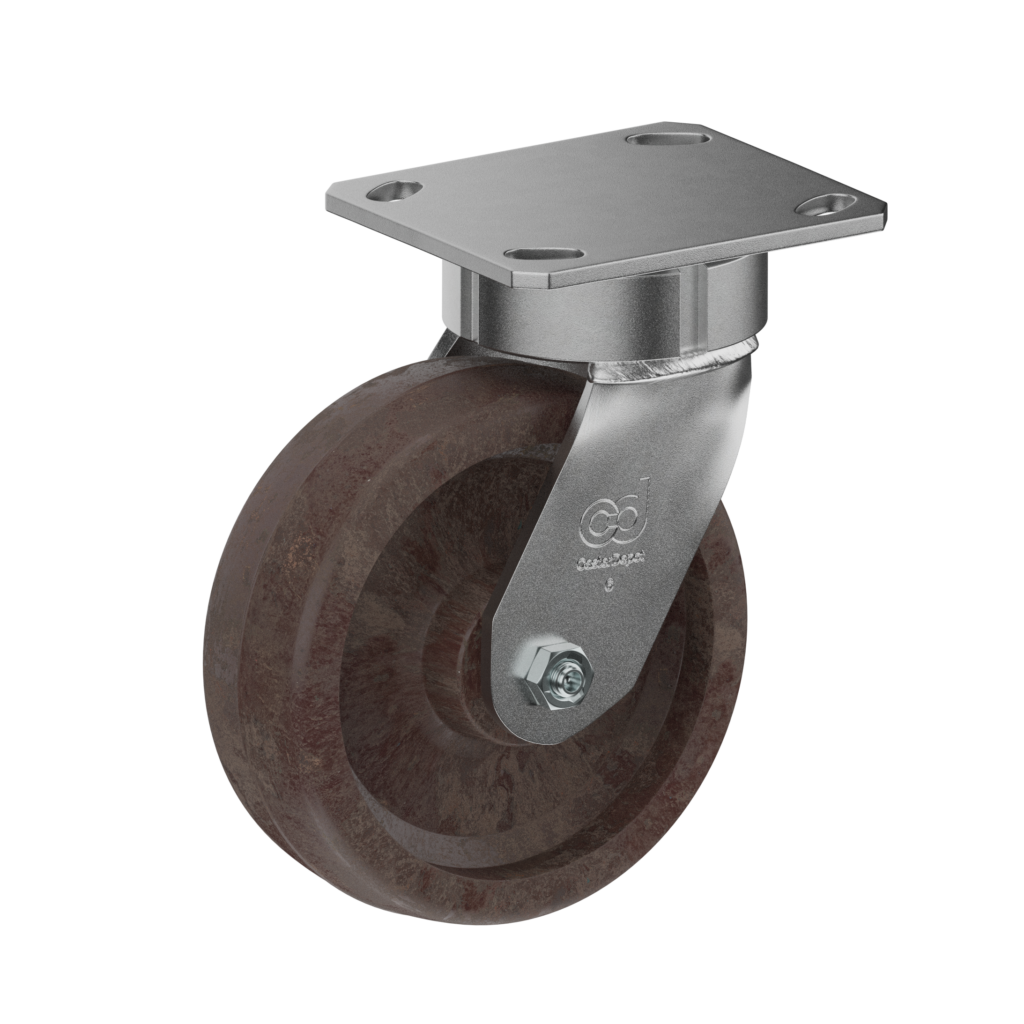
    Cast iron
    Flat
    Roller


    Why This Solution Worked

    Improved Temperature Capability

    Cast iron wheels maintain structural and dimensional integrity at elevated temperatures where polymer-based wheels begin to soften or deform. Temperature capability is the primary weighting factor in high-heat environments, and this material shift directly addressed that requirement.


    Dimensional Stability Under Thermal Load

    Unlike thermoplastic cores, cast iron maintains shape and mechanical properties during repeated heat cycles. This prevented flat spotting and reduced progressive distortion under load.


    Stable Bearing Interface

    With a rigid, heat-stable wheel structure, the roller bearing operated under consistent alignment. Load distribution remained controlled, restoring predictable rolling performance.

    The improvement was not a single-component fix. It was the result of aligning tread material, hub structure, and bearing performance with the dominant environmental variable: sustained heat.


    Results

    • Elimination of visible wheel distortion under welding-zone heat exposure
    • Reduced flat spotting during stationary dwell with hot parts
    • Restored predictable rolling resistance across production cells
    • Decreased caster replacement frequency and related downtime

    “We stopped chasing wheel failures once we matched the material to the environment.”


    Key Takeaway

    In high-heat fabrication environments, structural load capacity does not guarantee application suitability. Temperature capability must be evaluated before maneuverability preferences or rolling feel.

    Caster performance is the result of interaction between wheel material stability, hub structure, and bearing alignment. When thermal exposure is the dominant variable, the entire mobility system must be selected around heat resistance—not just capacity.


    How CasterDepot Can Help

    For over 45 years, CasterDepot has helped metal fabrication operations engineer mobility solutions that perform under real-world conditions—not just on spec sheets.


    Next steps:
    Talk it through with your local CasterHead®
    Discuss pricing and lead time
    Request supporting documentation
    Test a sample in your application


    Contact us now at https://www.casterdepot.com/contact/ or call one of our CasterHead® at 888.907.9952

  • Improving Caster Reliability in Food Processing Washdown Environments


    Company Overview

    A regional food processing facility specializing in prepared proteins and packaged ready-to-eat products operates across multiple shifts each day. Sanitation protocols require full washdown at the end of every production window.

    Carts are used continuously to move raw materials, in-process racks, and finished goods between processing, chilling, and packaging areas. Mobility reliability directly affects sanitation efficiency and production restart timing.


    Business Challenge

    Over a six-month period, the maintenance team recorded a measurable increase in caster replacements following repeated washdown cycles.

    “Every time we sanitized, it felt like we were shortening the life of the carts.”

    Wheels began showing surface cracking and dimensional instability. Rolling resistance increased noticeably after sanitation. Some carts were removed from service entirely due to visible degradation and unpredictable handling.

    Downtime increased. Replacement costs rose. Operator confidence declined during already tight production windows.

    Nothing was overloaded. Nothing was abused.
    The system was simply misaligned with its environment.


    Existing Caster Configuration (Before)

    Rig:
    5x2"
    Kingpin & rigid combo
    Zinc-plated steel


    Wheel:
    Phenolic resin
    Flat
    Roller


    Observed Result:
    Surface cracking, increased rolling resistance, and instability after repeated hot washdown cycles.


    What Was Really Happening

    The original configuration was selected around cost and load capacity rather than environmental survivability. In washdown environments, that priority sequence matters.


    1. Environmental Exposure Outweighed Load Demands

    Phenolic resin performs well under compressive load, but washdown environments introduce different stressors: chemical exposure, moisture absorption, and thermal cycling.

    Repeated hot water and sanitation chemical exposure accelerated surface breakdown and dimensional change. What met load requirements did not meet environmental demands.


    2. Corrosion Risk in Structural Components

    Zinc-plated steel performs adequately in dry or intermittent moisture conditions. However, in daily sanitation cycles, moisture and cleaning agents increase oxidation risk.

    As corrosion began forming, structural integrity and long-term rig stability became increasingly vulnerable.


    3. Moisture Interaction at the Floor Interface

    The flat tread profile increased contact area and retained moisture longer at the floor interface. Extended exposure periods compounded chemical and water interaction at the most stressed portion of the wheel.

    Dimensional instability in the wheel transferred additional stress into the roller bearing. Increased internal friction compounded rolling resistance, accelerating system-wide degradation.


    This was not a single-component failure. It was environmental incompatibility across wheel, rig, and bearing interaction.


    Recommended Solution

    The revised configuration was engineered around washdown survivability as the primary design constraint. Chemical resistance, corrosion resistance, and moisture stability were prioritized before load considerations.


    Updated Caster Configuration

    Rig:
    5x2"
    Kingpinless & rigid combo
    Stainless steel


    Wheel:
    Solid polyurethane
    Crowned
    Pedestal ball (Stainless)


    Why This Solution Worked


    Corrosion-Resistant Structural Foundation

    Upgrading to stainless steel addressed continuous moisture and chemical exposure at the rig level. Corrosion resistance became a baseline property rather than a vulnerability.


    Chemically Stable Wheel Material

    Solid polyurethane offers improved resistance to moisture and sanitation chemicals compared to phenolic resin in this duty class.

    Its elastomeric structure tolerates repeated thermal and chemical cycling without the cracking behavior previously observed. Dimensional stability remained consistent across sanitation cycles.


    Reduced Moisture Retention at the Floor Interface

    The crowned tread geometry reduced sustained flat contact and improved water shedding during and after washdown. This limited exposure duration and reduced surface stress concentration.


    Controlled Rolling Performance in Wet Conditions

    The pedestal ball bearing supported load while maintaining smoother rolling characteristics in environments where moisture exposure is routine.

    With improved wheel dimensional stability, bearing stress remained consistent, preventing the progressive rolling resistance increase seen previously.


    The result was not simply a stronger wheel.
    It was a mobility system aligned to environmental reality.


    Results

    • Significant reduction in caster replacements following washdown cycles
    • Improved rolling consistency before and after sanitation
    • Decreased maintenance intervention during production weeks
    • Increased operator confidence in cart reliability

    “We stopped treating casters like consumables and started treating them like part of the sanitation system.”


    Key Takeaway

    In washdown environments, mobility performance is dictated by chemical compatibility, moisture behavior, and thermal cycling stability—not load rating alone. A caster that meets weight requirements can still fail prematurely if environmental variables are not prioritized.

    Reliable performance emerges from alignment between wheel material, rig corrosion resistance, and bearing stability. When those elements are engineered as a system, sanitation cycles stop being a failure trigger and become a survivable operating condition.


    How CasterDepot Can Help

    For over 45 years, CasterDepot has helped food processing operations engineer mobility solutions that perform under real-world conditions—not just on spec sheets.


    Next steps:
    Talk it through with your local CasterHead®
    Discuss pricing and lead time
    Request supporting documentation
    Test a sample in your application


    Contact us now at https://www.casterdepot.com/contact/ or call one of our CasterHead® at 888.907.9952

  • Improving Ergonomics for Mobile Growing Tables in Greenhouse Operations


    Company Overview

    A regional nursery and greenhouse operation supplies ornamental plants, shrubs, and seasonal inventory to garden centers and commercial landscapers. Their operation runs six days a week, with carts continuously moving plant material between propagation areas, watering zones, and outbound staging.

    Plant transport racks routinely transition between smooth greenhouse concrete floors and exterior compacted gravel lanes, creating a mixed-surface mobility environment.


    Business Challenge

    Over the past six months, employees reported increasing push effort when moving fully loaded plant racks. What was once a smooth transfer between greenhouse bays and exterior gravel lanes began to feel resistant and unstable during turns. Productivity slowed, and team members rotated more frequently due to fatigue complaints.

    "Even when the racks aren't full, they just don't want to start rolling or track straight anymore."

    Management initially suspected load weight as the primary factor, but partially loaded racks demonstrated the same resistance and steering instability.


    Existing Caster Configuration (Before)

    Rig:
    5x2"
    Kingpin & rigid combo
    Zinc-plated steel


    Wheel:
    TPE on polypropylene
    Crowned
    Roller

    Observed Result:
    Increased push effort and instability during directional changes, especially across surface transitions between concrete and gravel.


    What Was Really Happening

    Although the configuration met medium-duty load requirements, ergonomic performance was being driven by how the wheel material and geometry behaved under sustained push-and-turn conditions across mixed surfaces.


    1. Tread Deformation Increasing Start-Up Resistance

    TPE provides cushioning and vibration dampening, but under sustained medium-duty loading, it deforms more significantly during start-up and directional change.


    Each time an operator initiated movement, part of their input energy was absorbed into tread deformation rather than translated into forward motion. On gravel transitions, that deformation increased further as the tread conformed to surface irregularities.


    This material-driven energy absorption translated directly into higher perceived push force.


    1. Crowned Face Concentrating Load During Turns

    The crowned profile concentrated contact pressure toward the center of the tread. Under load, this increased localized deflection during steering corrections.


    Instead of maintaining a stable, predictable contact patch, the wheel compressed and re-centered repeatedly during turns. Operators experienced this as instability and increased correction effort—particularly when redirecting carts between greenhouse rows or aligning with staging lanes.


    1. Bearing Efficiency Limited by Material Behavior

    Roller bearings supported sustained rolling once motion was established. However, they could not offset the resistance introduced by tread deformation during start-up and turning.


    The bearing performed as designed, but the dominant source of resistance originated at the tread-to-floor interface. In this case, optimizing bearing performance could not correct a material-driven increase in rolling resistance.


    Recommended Solution

    After reviewing surface transitions, sustained usage cycles, and operator fatigue reports, the revised configuration prioritized dimensional stability, reduced tread deflection, and more predictable tracking during directional change.


    Updated Caster Configuration

    Rig:
    5x2"
    Kingpin & rigid combo
    Zinc-plated steel

    Wheel:
    Glass-filled nylon
    Crowned
    Pedestal ball


    Why This Solution Worked

    Reduced Energy Loss from Tread Deformation

    Glass-filled nylon provides significantly higher hardness and lower deformation under load compared to TPE.

    During start-up and steering transitions, more operator input was converted directly into forward motion rather than absorbed into tread compression. This reduced the force required to initiate movement, particularly on compacted gravel.


    More Predictable Steering Response

    With minimal tread deflection, the crowned profile no longer amplified instability. Instead, it supported controlled directional change without the repeated compression-and-release behavior seen in the softer tread.

    The wheel maintained a more consistent contact patch during turns, reducing corrective effort.


    Bearing Supporting Efficient Rolling

    The pedestal ball bearing reduced rotational friction once motion began, complementing the stiffer tread structure.

    Because the primary source of resistance—tread deformation—was minimized, the bearing could now operate within a more efficient rolling system.


    Improved Performance Across Surface Transitions

    On smooth greenhouse concrete, the harder wheel rolled with less energy absorption. On compacted gravel, its dimensional stability prevented excessive deflection and drag.

    The overall system became more predictable across both environments.


    Results

    • Noticeable reduction in start-up push force
    • Improved steering stability between greenhouse rows
    • Reduced operator fatigue during long transfer cycles
    • More consistent tracking across concrete-to-gravel transitions


    Key Takeaway

    Ergonomic performance in mixed-surface applications is primarily governed by how wheel material and geometry manage energy under load. Softer treads may reduce vibration, but under sustained push-and-turn cycles, deformation can significantly increase rolling resistance and operator fatigue.

    Caster performance must be evaluated as an integrated system. Wheel material, face geometry, and bearing efficiency interact under real-world surface conditions. When material-driven resistance is resolved first, bearing and rig components can perform as intended—resulting in balanced, predictable mobility.


    How CasterDepot Can Help

    For over 45 years, CasterDepot has helped Nursery & Greenhouse operations engineer mobility solutions that perform under real-world conditions—not just on spec sheets.

    Next steps:

    • Talk it through with your local CasterHead®
    • Discuss pricing and lead time
    • Request supporting documentation
    • Test a sample in your application


    Contact us now at https://www.casterdepot.com/contact/ or call one of our CasterHead® at 888.907.9952

  • Reducing Noise and Vibration in Touring Road Cases for Live Events


    Company Overview

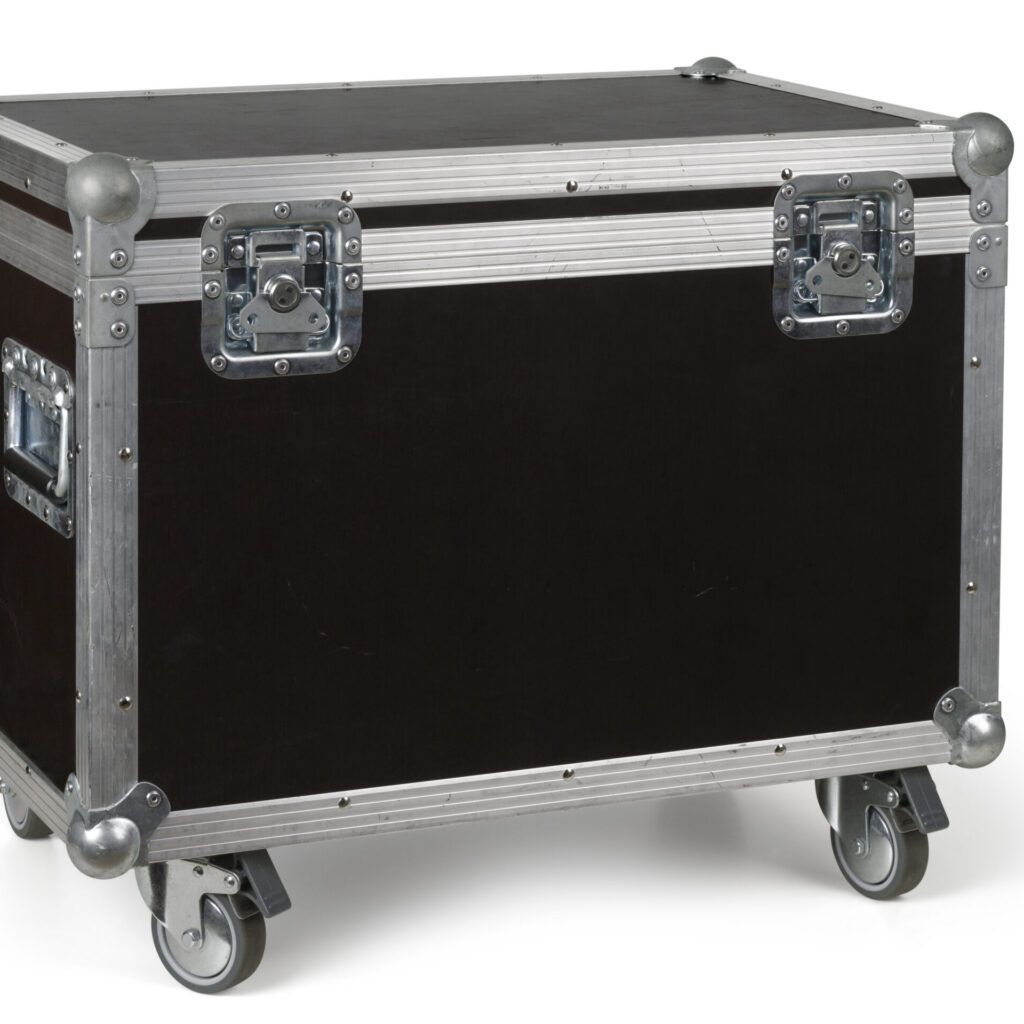
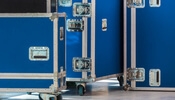
    A regional audio-visual production company provides staging, sound, and visual support for touring musicians and high-profile corporate events. Their equipment is transported in custom road cases that are moved constantly during load-in and load-out across ballrooms, theaters, hotels, conference centers, and other venues.

    In these environments, professionalism isn’t judged only by the show itself—it’s judged during the moments before and after, when crews are moving gear through quiet venues, past staff, and across finished floors.


    Business Challenge

    The company began receiving informal complaints from venue staff and event managers during load-in and load-out.

    "A customer told us he could hear our cases before he could see them. And he wasn't joking."

    The road cases themselves were structurally sound and protected the equipment inside. The problem showed up during movement.

    As cases were pushed across floors, the caster system produced audible squeaking, rattling, and vibration. During quiet setup windows, this noise drew attention and made their otherwise professional crews sound rough and unprepared.

    Nothing was technically “broken”—but the cases sounded unsettled, noisy, and harder to manage than they should have been.

    The issue wasn’t failure.
    It was friction, noise, and perception.


    What Was Really Happening

    A technical review of the existing caster configuration identified three issues that were easy to overlook on paper, but obvious in real-world use.

    1. Excessive Noise from Hard Tread Material

    The existing phenolic resin wheels produced high-frequency rolling noise on smooth floors. In quiet venues, that noise carried farther than expected and became noticeable well before cases reached their destination.

    In practice, this made routine load-ins feel louder and more disruptive than crews intended.

    2. Vibration Transfer Through a Rigid Wheel Core

    Because the wheel construction was rigid, small floor irregularities were transmitted directly into the case.

    Instead of rolling smoothly, cases tended to chatter and rattle—especially during longer pushes or direction changes. While the gear inside wasn’t being damaged, the movement felt rough and sounded worse than it should have.

    3. Inconsistent Rolling from Bearing Friction

    The plain-bore wheel design created uneven rolling resistance.

    From an operator’s perspective, cases didn’t start or steer consistently. That meant more effort during long pushes and more correction when navigating tight spaces during setup.


    Existing Caster Configuration (Before)

    Rig:

    • 3.5" × 1.25" Kingpin Swivel
    • Zinc-plated steel

    Wheel:

    • Phenolic resin
    • Plain bore

    Observed Result:
    Durable enough to survive touring use—but poorly suited for quiet venues, finished floors, and frequent manual handling.


    Recommended Solution

    After reviewing how the cases were actually used—including floor conditions, load weights, travel paths, and frequency of movement—we recommended a revised caster system that prioritized smooth, controlled movement without sacrificing durability.


    Updated Caster Configuration

    Rig:

    • 4" × 1.25" Kingpin Swivel

    Wheel:

    • TPR tread
    • Polypropylene core
    • Precision ball bearing


    Why This Solution Worked

    Quieter Movement in Real Venues

    The TPR tread created a softer rolling interface, significantly reducing squeak and floor resonance on polished surfaces. As a result, cases moved across surfaces without drawing unnecessary attention during quiet load-ins.


    Reduced Rattle and Vibration

    The elastomeric tread absorbed small impacts and micro-vibrations that previously traveled into the case. Movement felt more settled, and cases no longer sounded rough or unstable while rolling.


    More Predictable Rolling and Steering

    The precision ball bearing reduced rolling friction and eliminated the start-stop behavior operators experienced with plain-bore wheels. Cases started more easily, tracked better, and required less correction when maneuvering through tight spaces.


    Easier Handling During Long Load-Ins

    Increasing the wheel diameter to 4" improved obstacle clearance and reduced push force. Over longer distances, cases felt easier to manage and required less physical effort from the crew.


    Results

    • Noticeable reduction in rolling noise during setup and teardown
    • Smoother, more controlled case movement across event venues
    • Improved perception of professionalism among venue staff and clients
    • Reduced crew fatigue during long load-ins and repositioning

    While the original caster configuration met basic durability requirements, the upgraded solution aligned mobility performance with the real-world expectations of live event environments.

    "I don't think we really knew how much we were hurting our reputation. What a difference!" 


    Key Takeaway

    In noise-sensitive, customer-facing environments, caster selection affects more than mobility—it shapes how professional a crew appears before the show even starts.

    By matching tread material and bearing design to how road cases are actually used, this AV production company eliminated unnecessary noise, reduced handling effort, and improved the overall load-in experience.


    How CasterDepot Can Help

    For over 45 years, CasterDepot has helped road-case operations engineer mobility solutions that perform under real-world conditions—not just on spec sheets.

    Next steps:

    • Talk through your application with a local CasterHead®
    • Review pricing and lead times
    • Request supporting documentation
    • Test a sample in your environment.


    Contact us now at https://www.casterdepot.com/contact/ or call one of our CasterHead® about your Road Case setup at 888.907.9952

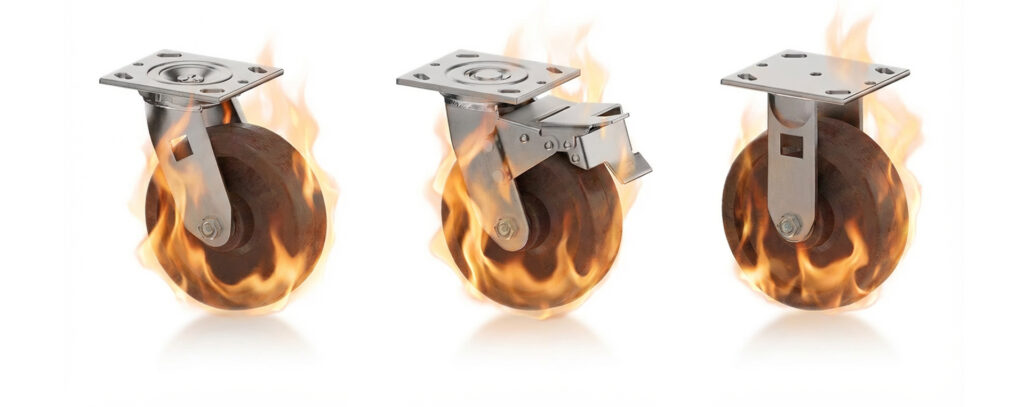
  • High-Temp Nylon Casters: Built for the Heat of Metal Fabrication


    In metal fabrication, extreme heat isn’t the exception - it’s the environment. From laser and plasma-cutting stations to powder coating lines and curing ovens, every phase of the process subjects equipment to intense temperatures that can degrade standard casters and wheels. When mobility must continue under heat, the solution lies in high-temperature nylon wheels paired with bronze bearings - a combination engineered to withstand the pressure and keep productivity rolling.


    Why Heat Resistance Matters

    Metal fabrication involves processes that regularly expose carts, racks, and platforms to temperatures exceeding 400°F. During coating, curing, or post-weld operations, heat radiates from furnaces and ovens, often affecting nearby equipment. Standard rubber or polyurethane wheels can soften, deform, or seize under such thermal stress, leading to damaged floors, operator strain, and costly downtime. For operations where flow efficiency and safety are critical, this kind of failure simply isn’t an option.

    That’s why heat-resistant casters are not just a performance upgrade - they’re an operational necessity.


    The High-Temp Nylon Advantage

    High-temp nylon wheels are specifically formulated to retain strength and dimensional stability even under sustained exposure to elevated heat. Unlike conventional plastics that may lose shape or melt, high-temp nylon maintains its integrity through repeated heating and cooling cycles.

    Its low thermal conductivity protects bearings and mounts from heat transfer, while its non-marking, chemical-resistant surface prevents floor damage and contamination in coating or finishing areas. These wheels deliver the consistent, reliable performance fabricators need to keep production lines moving through the heat of welding and finishing environments.


    Bronze Bearings: Precision That Endures the Heat

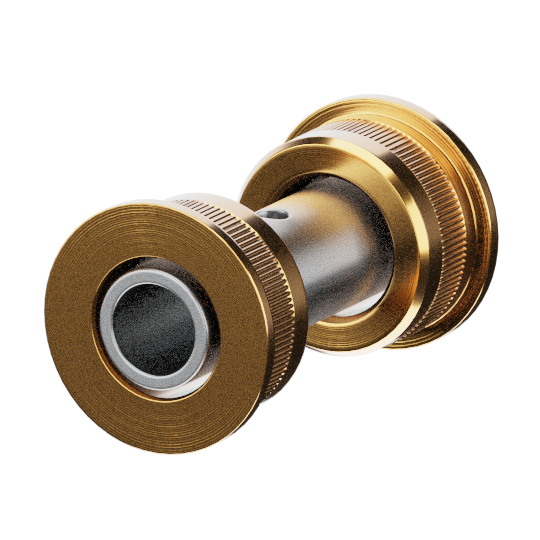
    Paired with bronze bearings, these casters gain another layer of performance. Bronze bearings are built for continuous use in high-temperature applications where traditional lubricants would break down. The material’s inherent lubricity ensures smooth, quiet rotation without the need for grease. Bronze bearings also resist corrosion from metal dust, chemical cleaners, and humidity in finishing booths, providing long service life and consistent mobility under punishing conditions.


    Keeping Fabrication Moving - Even When It’s Hot

    Metal fabrication is all about control over temperature, material, and movement. Choosing casters that perform under heat isn’t just about longevity; it’s about keeping workflows safe, efficient, and uninterrupted. High-temp nylon wheels with bronze bearings deliver the kind of performance that keeps productivity steady even when the heat is on.


    At CasterDepot, our CasterHeads® help manufacturers and fabricators select caster solutions tailored to their most demanding conditions. From oven-line mobility to high-heat workstations, we’ve got the wheels to keep your operation rolling — no matter how hot the job gets.

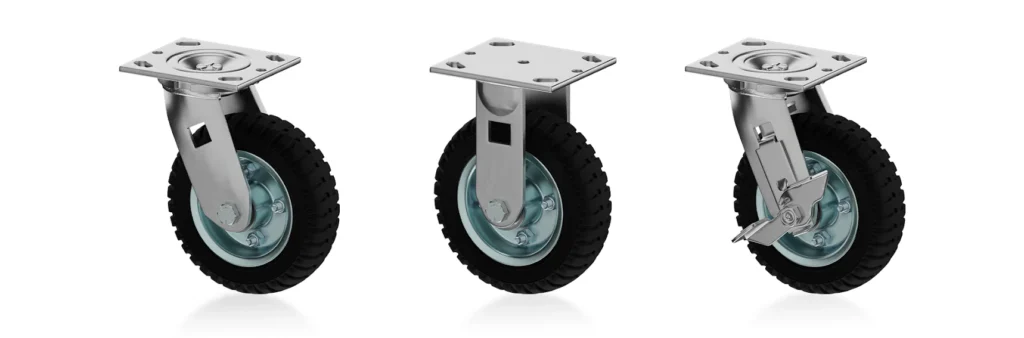
  • Semi-Pneumatic Strength: The All-Terrain Upgrade for Your Road Cases

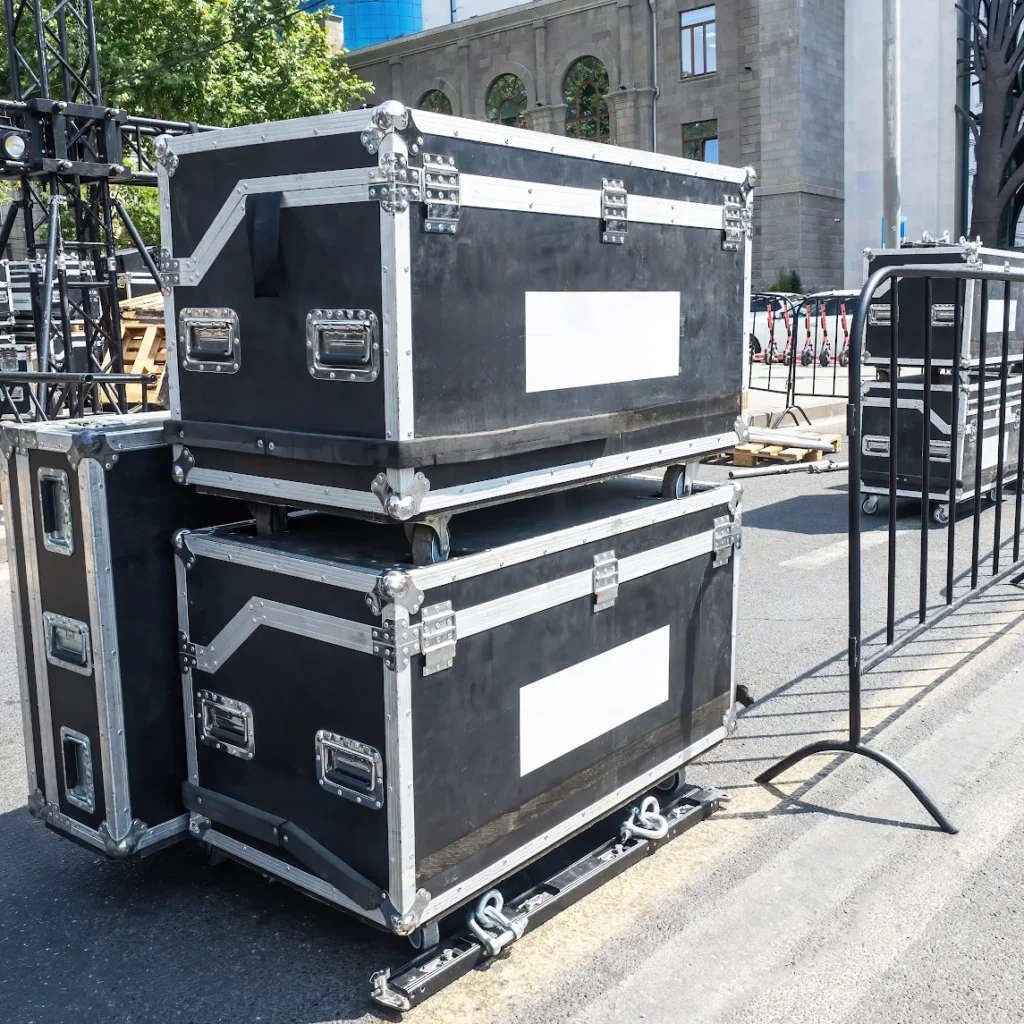
    When you’re on the road, every setup counts — and downtime is the enemy. Between airports, arenas, and outdoor festivals, your road cases take a beating. That’s why more touring professionals are switching to semi-pneumatic casters — the all-terrain solution that keeps your gear moving, no matter where the show takes you.


    The Problem with Air-Filled Wheels

    Traditional pneumatic wheels offer great shock absorption, but they come with one major drawback: air pressure maintenance. Slow leaks, punctures, or temperature changes can quickly leave you with a flat — and no one wants to waste precious load-in time checking tire pressure.


    The Semi-Pnuematic Advantage

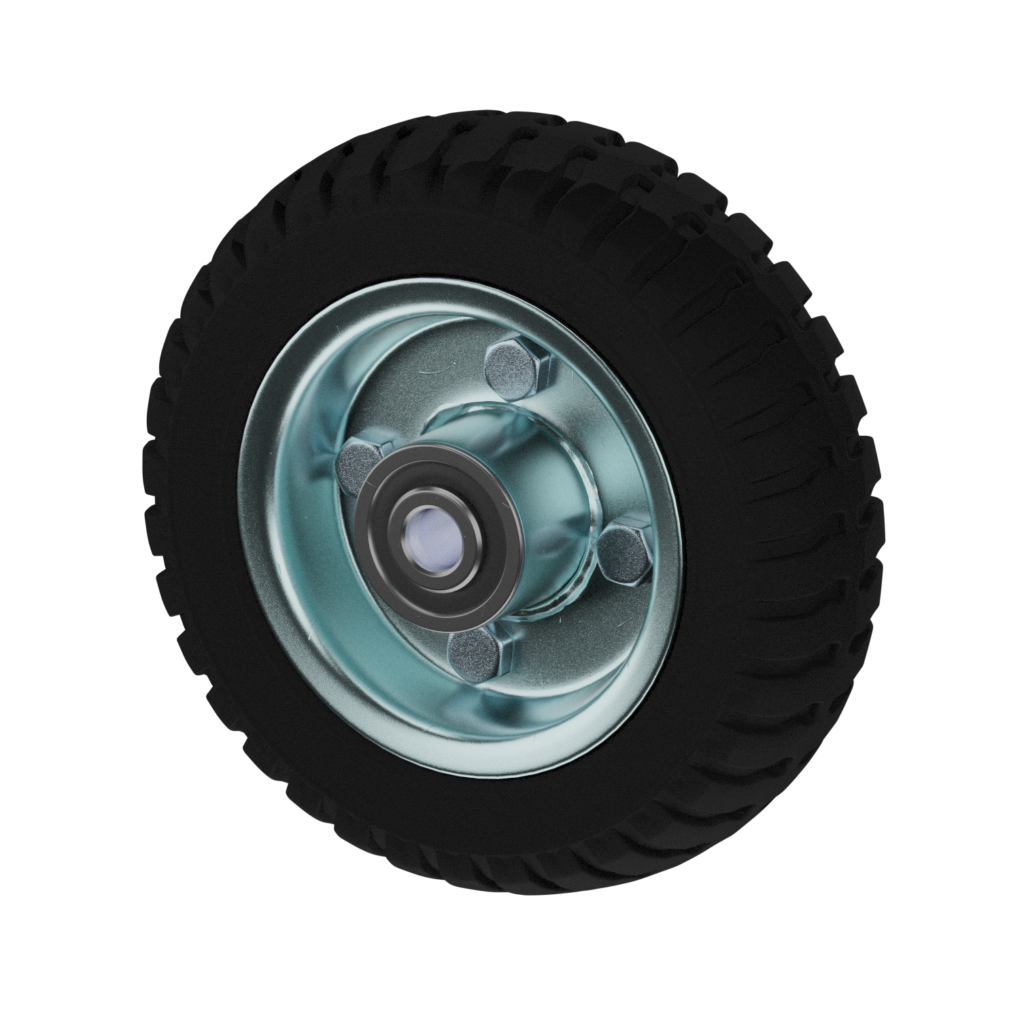
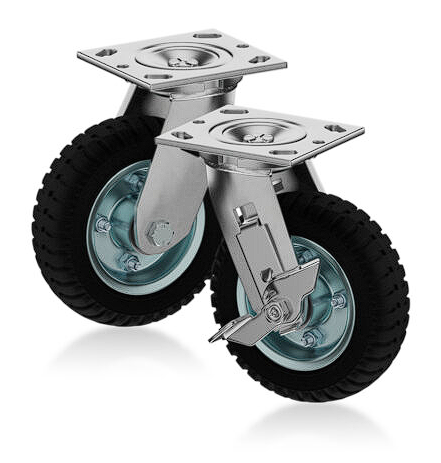
    Semi-pneumatic casters combine the best of both worlds: the cushioned ride of pneumatics with the reliability of a solid core. Instead of air, they’re manufactured from solid monoprene that can’t puncture or deflate. The result?

    • Zero downtime: No flats, no refills, no pressure checks.
    • All-terrain mobility: Rolls smoothly across gravel, grass, or asphalt.
    • Shock protection: Absorbs impact and vibration, keeping your gear safe.
    • Long-term durability: Resistant to cracks, moisture, and debris.


    Whether you’re moving lighting rigs, AV systems, or production gear, semi-pneumatic casters help maintain the speed and control your crew depends on.


    Perfect for Touring and Production Pros

    Semi-pneumatic casters are built for the realities of the road: fast setups, unpredictable environments, and heavy loads that can’t wait. They make an ideal upgrade for road cases, speaker stacks, stage carts, and outdoor production equipment — anything that needs to move over mixed surfaces without the hassle of maintenance.


    At CasterDepot, we stock semi-pneumatic casters engineered for professional touring use. Available in different sizes and colors, they’re designed to deliver quiet, shock-absorbing mobility — with the confidence that your cases will keep rolling show after show.

    When reliability and performance matter most, semi-pneumatic casters give your road cases the edge they deserve so your gear stays protected and your schedule stays on track.


  • White Nylon: Built for Compliance in Food Processing


    When it comes to mobility in food processing facilities, compliance isn’t optional - it’s essential. From production lines to packaging areas, every component of your equipment must meet strict health, safety, and environmental standards. That’s where white nylon casters stand out.


    Why White Nylon?

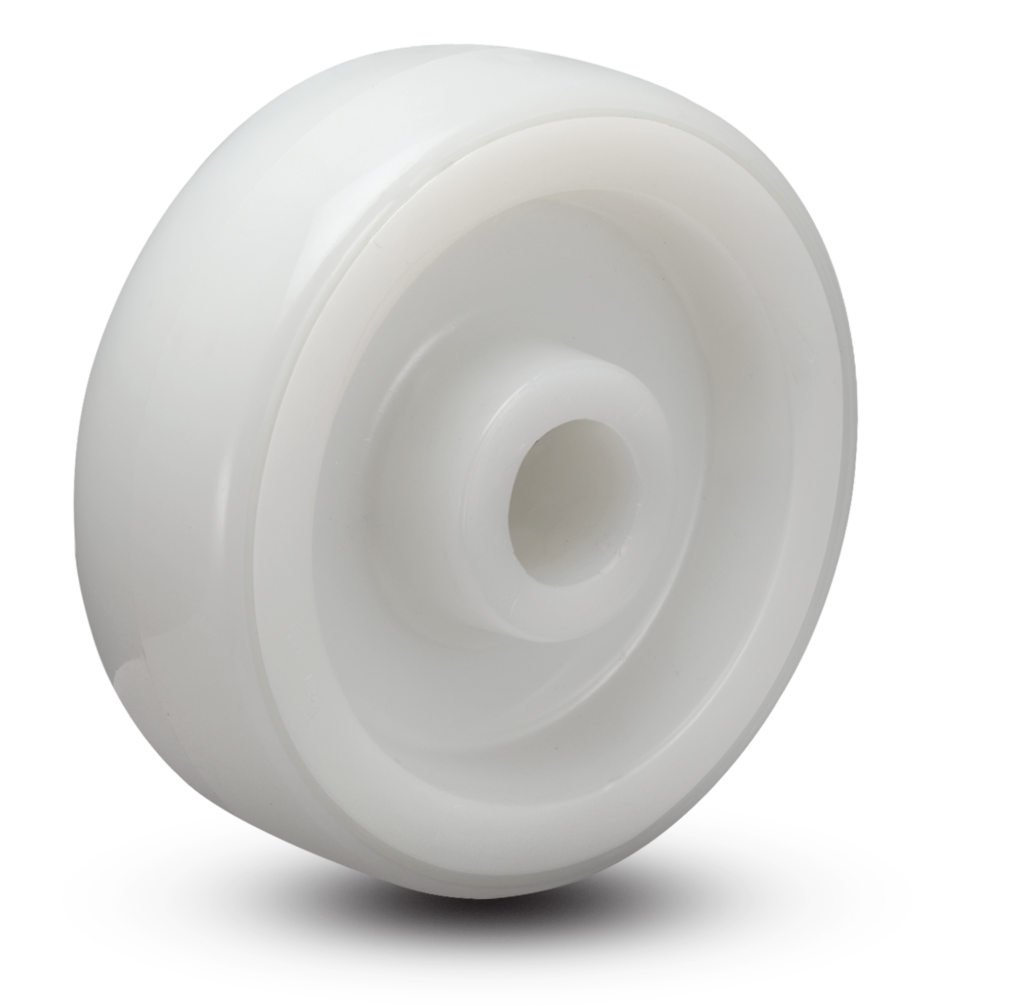
    White nylon wheels are widely recognized in the food industry for their clean, non-marking, and moisture-resistant properties. But beyond their durability and performance, their greatest strength lies in regulatory compliance.


    NSF-Certified Mobility

    The NSF (National Sanitation Foundation) certification is a gold standard in the food industry. Casters that are NSF-certified are tested to ensure they meet rigorous requirements for sanitation, safety, and reliability in food environments. For processors, this means:

    • Casters are built with materials suitable for direct food contact zones.
    • Designs prevent the buildup of dirt, bacteria, and contaminants.
    • Confidence that your mobility equipment aligns with food safety audits and regulatory inspections.


    Performance Meets Compliance

    Regulatory approval is critical, but food processors also need casters that can withstand harsh washdowns, heavy loads, and constant movement. White nylon casters meet these demands by offering high load capacities for heavy-duty equipment, excellent moisture and chemical resistance to handle frequent sanitation cycles, and non-marking wheels that help preserve facility cleanliness.


    In food processing, compliance equals trust. White nylon casters with NSF certifications offer more than mobility - they deliver peace of mind that every move meets the highest standards for food safety, worker protection, and environmental responsibility. 

  • Albion Monoprene Semi-Pneumatic Wheels: The Flat-Free, Maintenance-Free Solution for Nursery & Greenhouse Mobility


    In nursery and greenhouse operations, mobility equipment takes a beating. From rolling over gravel paths and soil beds to maneuvering through narrow greenhouse aisles, casters need to deliver smooth, stable movement without breaking down. That’s where Albion Monoprene Semi-Pneumatic wheels excel. Built from a proprietary solid monoprene rubber, these wheels are designed to provide the performance of pneumatic tires while eliminating the biggest hassle: flats. Whether you're transporting propagation racks or heavy grow tables, Albion Monoprene Semi-Pneumatic wheels offer a dependable, maintenance-free solution that’s ideal for year-round use in demanding horticultural environments.


    The Problem with Pneumatic Wheels in Growing Operations

    While pneumatic wheels are known for their cushioned ride, they’re also prone to punctures, pressure loss, and blowouts especially in rugged nursery and greenhouse settings. Sharp rocks, rough terrain, and daily wear can cause unexpected flats, leading to stalled operations, increased labor costs, and unplanned equipment maintenance. During peak growing seasons, the downtime caused by a single failed wheel can ripple across the entire workflow. Replacing tubes or re-inflating tires becomes a recurring and costly chore. For operations that rely on consistency and efficiency, pneumatic wheels often fall short of what’s needed in the field.


    Built for Nursery & Greenhouse Applications

    Albion Monoprene Semi-Pneumatic wheels were made with growers in mind. Their solid rubber construction prevents flats, making them ideal for carts and equipment that operate across gravel paths, mulch-covered terrain, or damp greenhouse floors. The wheels absorb shocks, reduce vibration, and roll smoothly even when fully loaded. That’s why they’re commonly used on propagation racks, soil bin carts, mobile potting tables, irrigation wagons, and harvest trolleys. With their balance of strength and ride quality, Albion Monoprene Semi-Pneumatic wheels are the right fit for any growing application where rugged terrain meets daily use.


    Key Features & Benefits

    Albion Monoprene Semi-Pneumatic wheels feature a solid, flat-free design that removes the need for air pressure or inflating equipment. Despite being solid, the special monoprene compound delivers a cushioned, pneumatic-like ride, making it easier to push heavy loads over uneven or soft surfaces. These wheels are non-marking, meaning they won’t scuff indoor floors or greenhouse mats, and they’re also highly resistant to cracking, chunking, or tearing. Most importantly, they’re completely maintenance-free - install them once, and they keep rolling.


    Why Growers Choose Albion Monoprene Semi-Pneumatic wheels

    Growers need equipment they can count on, and Albion Monoprene Semi-Pneumatic wheels check all the boxes. They eliminate downtime from flats, reduce maintenance costs, and make daily tasks easier for staff by providing smooth and consistent movement over varied terrain. Their long lifespan means fewer replacements and better return on investment, especially in operations where carts are used heavily throughout the day. By switching to Albion Monoprene Semi-Pneumatic wheels, nurseries and greenhouses can upgrade their mobility systems with confidence knowing they’ve invested in a wheel that delivers durability, comfort, and zero-maintenance performance.

  • Total Lock, Total Control: How Road Cases Stay Secure with Total Lock Brakes

    When it comes to transporting valuable equipment, reliability doesn’t end at the destination. Road cases may be built to take a beating, but if they shift or roll at the wrong time, the consequences can be costly.

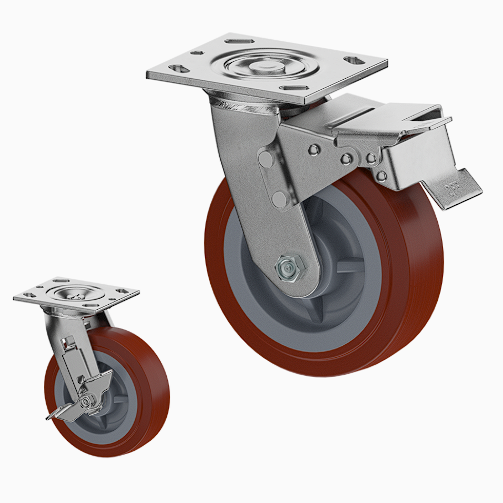
    That’s where total lock casters come in. Unlike standard brakes that only stop the wheel, total lock brakes immobilize both the wheel and the swivel. This dual-action system keeps the entire road case locked in position - no accidental rolling, no unexpected swiveling.

    CasterHead® Travis Popma says, “A total lock brake simultaneously locks the wheel and the swivel section of the caster, making your application more stable.  This feature creates a safer work environment and peace of mind. “


    The Difference Between Standard Brakes and Total Lock Brakes

    Most traditional casters come with single-action brakes that stop the wheel from rolling but they don’t prevent the swivel from rotating. That means the case can still pivot or shift, especially on sloped or uneven surfaces. Total lock brakes address this by locking both axes at once. The result? Complete stability wherever you park the case.

    This is particularly important in environments with high activity, such as backstage areas, production sets, or convention centers. A small shift in equipment placement can lead to accidents, costly damage,  or cause delays in tight production timelines.


    When Every Second - and Inch - Matters

    In the live event and entertainment industries, time is everything. Crews are working under pressure, and road cases need to move fast when they need to, and stay put when they don’t. Whether you're running cables, setting up lighting, or queuing AV gear, knowing that your cases won’t budge under pressure allows you to focus on the task at hand.

    For touring professionals, total lock casters are a game-changer. They simplify load-in and load-out, help keep gear organized during prep, and reduce the risk of damage to high-value equipment. Even in mobile applications like outdoor events or temporary broadcast setups, total lock brakes bring crucial control to unpredictable environments.


    Choosing the Right Caster Configuration

    While total lock brakes add valuable stability, they work best when paired with the right caster materials and sizes for your environment. For example:

    • Polyurethane-on-aluminum wheels offer high load capacity and floor protection - great for studio floors or smooth concrete.
    • Polyurethane-on-polypropylene wheels offer excellent weatherability and floor protection - great for outdoor or element-exposed use.
    • Rubber wheels provide vibration dampening for sensitive AV gear.


    At CasterDepot, we help production crews, case manufacturers, and event managers find the right balance between mobility and control.

Items 11 to 20 of 279 total

Page:
  1. 1
  2. 2
  3. 3
  4. 4
  5. 5
  6. ...
  7. 28