












Company Overview
A regional metal fabrication company produces welded steel frames and structural assemblies for industrial equipment manufacturers. Their production floor runs multiple fabrication cells, each using mobile weld tables and fixture carts that move between cutting, welding, grinding, and finishing stations throughout the day.
These carts frequently operate near active welding zones and often transport components immediately after welding, while parts are still radiating significant heat.
Business Challenge
Frequent caster failures began interrupting workflow across multiple shifts. Wheels were degrading faster than expected, resulting in unplanned maintenance, increased rolling resistance, and safety concerns on the production floor.
“The wheels just couldn’t handle the heat. We were replacing them far more often than we should have been.”
Employees observed visible wheel distortion and mobility changes after repeated exposure to elevated temperatures near welding operations.
The issue did not appear to be load-related.
It was temperature-related.
Existing Caster Configuration (Before)
Rig:
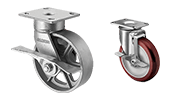
5x2"
Kingpin & rigid combo
Zinc-plated steel
Wheel:
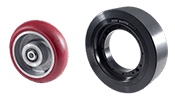
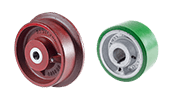
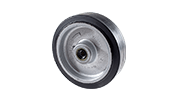
Polyurethane on polypropylene
Crowned
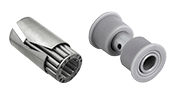
Roller
Observed Result:
Visible tread distortion, flat spotting, and increased rolling resistance after repeated exposure to elevated temperatures.
What Was Really Happening
The original configuration satisfied structural load requirements for medium duty use. On paper, it met capacity expectations.
However, high-heat applications prioritize temperature capability and tread performance stability at elevated temperatures as primary selection variables . In this environment, wheel material temperature resistance should have been the dominant decision driver.
1. Thermal Softening of the Tread
Polyurethane tread behavior changes as temperature increases. Repeated exposure to hot welded components and radiant heat pushed the tread outside its optimal hardness band.
Under load and thermal dwell, deformation became less controlled. Over time, this produced:
- Visible tread distortion
- Increased rolling resistance
- Flat spotting after stationary heat exposure
2. Dimensional Instability of the Hub Core
The polypropylene core contributed to reduced dimensional stability under sustained heat. In high-temperature environments, hub material performance is a documented evaluation factor.
As heat cycles accumulated, both tread and core experienced progressive performance changes.
3. Secondary Bearing Effects
The roller bearing was appropriate for load capacity. However, bearings depend on consistent wheel geometry. As the wheel deformed, load distribution through the bearing changed.
The bearing was reacting to instability—it was not the cause.
The failure was driven by material compatibility with sustained thermal exposure, not weight or bearing selection.
Recommended Solution
The revised configuration prioritized temperature capability and structural stability under sustained heat cycles. Rather than optimizing for floor feel or maneuverability first, wheel material selection was anchored to elevated temperature resistance and dimensional stability.
Updated Caster Configuration
Rig:
5x2"
Kingpin & rigid combo
Zinc-plated steel
Wheel:
Cast iron
Flat
Roller
Why This Solution Worked
Improved Temperature Capability
Cast iron wheels maintain structural and dimensional integrity at elevated temperatures where polymer-based wheels begin to soften or deform. Temperature capability is the primary weighting factor in high-heat environments, and this material shift directly addressed that requirement.
Dimensional Stability Under Thermal Load
Unlike thermoplastic cores, cast iron maintains shape and mechanical properties during repeated heat cycles. This prevented flat spotting and reduced progressive distortion under load.
Stable Bearing Interface
With a rigid, heat-stable wheel structure, the roller bearing operated under consistent alignment. Load distribution remained controlled, restoring predictable rolling performance.
The improvement was not a single-component fix. It was the result of aligning tread material, hub structure, and bearing performance with the dominant environmental variable: sustained heat.
Results
- Elimination of visible wheel distortion under welding-zone heat exposure
- Reduced flat spotting during stationary dwell with hot parts
- Restored predictable rolling resistance across production cells
- Decreased caster replacement frequency and related downtime
“We stopped chasing wheel failures once we matched the material to the environment.”
Key Takeaway
In high-heat fabrication environments, structural load capacity does not guarantee application suitability. Temperature capability must be evaluated before maneuverability preferences or rolling feel.
Caster performance is the result of interaction between wheel material stability, hub structure, and bearing alignment. When thermal exposure is the dominant variable, the entire mobility system must be selected around heat resistance—not just capacity.
How CasterDepot Can Help
For over 45 years, CasterDepot has helped metal fabrication operations engineer mobility solutions that perform under real-world conditions—not just on spec sheets.
Next steps:
Talk it through with your local CasterHead®
Discuss pricing and lead time
Request supporting documentation
Test a sample in your application
Contact us now at https://www.casterdepot.com/contact/ or call one of our CasterHead® at 888.907.9952