











Company Overview
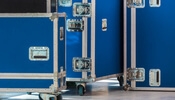
A regional audio-visual production company provides staging, sound, and visual support for touring musicians and high-profile corporate events. Their equipment is transported in custom road cases that are moved constantly during load-in and load-out across ballrooms, theaters, hotels, conference centers, and other venues.
In these environments, professionalism isn’t judged only by the show itself—it’s judged during the moments before and after, when crews are moving gear through quiet venues, past staff, and across finished floors.
Business Challenge
The company began receiving informal complaints from venue staff and event managers during load-in and load-out.
"A customer told us he could hear our cases before he could see them. And he wasn't joking."
The road cases themselves were structurally sound and protected the equipment inside. The problem showed up during movement.
As cases were pushed across floors, the caster system produced audible squeaking, rattling, and vibration. During quiet setup windows, this noise drew attention and made their otherwise professional crews sound rough and unprepared.
Nothing was technically “broken”—but the cases sounded unsettled, noisy, and harder to manage than they should have been.
The issue wasn’t failure.
It was friction, noise, and perception.
What Was Really Happening
A technical review of the existing caster configuration identified three issues that were easy to overlook on paper, but obvious in real-world use.
1. Excessive Noise from Hard Tread Material
The existing phenolic resin wheels produced high-frequency rolling noise on smooth floors. In quiet venues, that noise carried farther than expected and became noticeable well before cases reached their destination.
In practice, this made routine load-ins feel louder and more disruptive than crews intended.
2. Vibration Transfer Through a Rigid Wheel Core
Because the wheel construction was rigid, small floor irregularities were transmitted directly into the case.
Instead of rolling smoothly, cases tended to chatter and rattle—especially during longer pushes or direction changes. While the gear inside wasn’t being damaged, the movement felt rough and sounded worse than it should have.
3. Inconsistent Rolling from Bearing Friction
The plain-bore wheel design created uneven rolling resistance.
From an operator’s perspective, cases didn’t start or steer consistently. That meant more effort during long pushes and more correction when navigating tight spaces during setup.
Existing Caster Configuration (Before)
Rig:
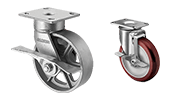
- 3.5" × 1.25" Kingpin Swivel
- Zinc-plated steel
Wheel:
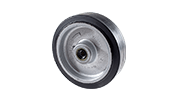
- Phenolic resin
- Plain bore
Observed Result:
Durable enough to survive touring use—but poorly suited for quiet venues, finished floors, and frequent manual handling.
Recommended Solution
After reviewing how the cases were actually used—including floor conditions, load weights, travel paths, and frequency of movement—we recommended a revised caster system that prioritized smooth, controlled movement without sacrificing durability.
Updated Caster Configuration
Rig:
- 4" × 1.25" Kingpin Swivel
Wheel:
- TPR tread
- Polypropylene core
- Precision ball bearing
Why This Solution Worked
Quieter Movement in Real Venues
The TPR tread created a softer rolling interface, significantly reducing squeak and floor resonance on polished surfaces. As a result, cases moved across surfaces without drawing unnecessary attention during quiet load-ins.
Reduced Rattle and Vibration
The elastomeric tread absorbed small impacts and micro-vibrations that previously traveled into the case. Movement felt more settled, and cases no longer sounded rough or unstable while rolling.
More Predictable Rolling and Steering
The precision ball bearing reduced rolling friction and eliminated the start-stop behavior operators experienced with plain-bore wheels. Cases started more easily, tracked better, and required less correction when maneuvering through tight spaces.
Easier Handling During Long Load-Ins
Increasing the wheel diameter to 4" improved obstacle clearance and reduced push force. Over longer distances, cases felt easier to manage and required less physical effort from the crew.
Results
- Noticeable reduction in rolling noise during setup and teardown
- Smoother, more controlled case movement across event venues
- Improved perception of professionalism among venue staff and clients
- Reduced crew fatigue during long load-ins and repositioning
While the original caster configuration met basic durability requirements, the upgraded solution aligned mobility performance with the real-world expectations of live event environments.
"I don't think we really knew how much we were hurting our reputation. What a difference!"
Key Takeaway
In noise-sensitive, customer-facing environments, caster selection affects more than mobility—it shapes how professional a crew appears before the show even starts.
By matching tread material and bearing design to how road cases are actually used, this AV production company eliminated unnecessary noise, reduced handling effort, and improved the overall load-in experience.
How CasterDepot Can Help
For over 45 years, CasterDepot has helped road-case operations engineer mobility solutions that perform under real-world conditions—not just on spec sheets.
Next steps:
- Talk through your application with a local CasterHead®
- Review pricing and lead times
- Request supporting documentation
- Test a sample in your environment.
Contact us now at https://www.casterdepot.com/contact/ or call one of our CasterHead® about your Road Case setup at 888.907.9952