











Company Overview
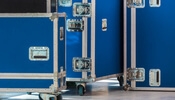
A mid-sized recreational boat manufacturer produces fiberglass boats ranging from 18 to 32 feet. Throughout the facility, partially assembled components are staged and transported between lamination, fitting, and final assembly areas using medium-duty material carts.
Each cart is moved repeatedly throughout the shift, often fully loaded with hardware kits, seating assemblies, and structural components.
Business Challenge
Over time, assembly teams began reporting increasing push effort and inconsistent maneuverability during routine cart movement.
"We were getting tired a lot faster than we should have been. Starting the carts and turning them just took too much effort."
The carts remained structurally intact and within rated load capacity. Nothing was failing mechanically.
However, operators described difficulty initiating motion and increased resistance during directional changes. Some employees began partially loading carts to reduce strain, slowing material flow between stations and introducing workflow inefficiencies.
The issue was not structural capacity. It was rolling efficiency under repetitive daily use.
Existing Caster Configuration (Before)
Rig:
5x2"
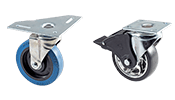
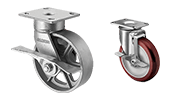
Kingpin & rigid combo
Zinc-plated steel
Wheel:
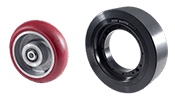
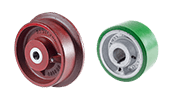
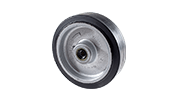
Rubber on cast iron
Crowned
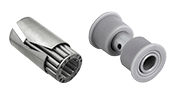
Roller
What Was Really Happening
A technical review of the mobility system identified that the ergonomic complaints were rooted in energy transfer behavior within the wheel assembly rather than structural inadequacy.
1. Energy Loss in the Rubber Tread
Rubber on cast iron provides cushioning, but under sustained medium-duty loads, the tread continuously deforms.
Each start and directional transition required the operator to overcome this deformation before forward motion could stabilize. Instead of efficiently returning energy into motion, the tread absorbed it. Over repeated cycles throughout the shift, that energy loss translated directly into increased push force and cumulative fatigue.
2. Crowned Contact Concentration
The crowned wheel face concentrated load toward the center of the tread. During initiation and steering transitions, localized compression increased, amplifying rolling resistance at the exact moment operators needed smooth response.
While crowned profiles can aid maneuverability in some applications, in this sustained ergonomic environment, they contributed to higher startup resistance.
3. Bearing Support Without Efficiency Optimization
Roller bearings supported radial load effectively and were structurally appropriate for the duty class.
However, they did not reduce deformation-driven rolling resistance occurring within the tread material. The bearing was not failing—but it was not offsetting the inefficiencies generated at the floor interface.
The system remained mechanically sound. It was simply inefficient for repetitive ergonomic use.
Recommended Solution
After reviewing load profiles, travel distance, movement frequency, and the ergonomic design priority, a revised configuration was recommended to reduce energy loss and improve rolling predictability while remaining within medium-duty constraints.
Updated Caster Configuration
Rig:
5x2"
Kingpinless & rigid combo
Zinc-plated steel
Wheel:
Heavy-duty glass-filled nylon
Crowned
Pedestal ball
Why This Solution Worked
Reduced Tread Deformation Under Load
Heavy-duty glass-filled nylon introduced a significantly more dimensionally stable rolling interface. With minimal tread compression, startup resistance decreased and energy transfer became more direct. Operators no longer had to overcome continuous elastic deformation during each push cycle.
Improved Rolling Efficiency and Energy Return
By minimizing energy absorption within the wheel, more applied force translated directly into forward movement. Repetitive travel between stations required less cumulative effort, addressing the core ergonomic complaint.
More Consistent Steering Response
The kingpinless & rigid combo configuration improved swivel stability under load. Combined with pedestal ball bearings, directional transitions became more predictable and required less corrective input.
The system functioned as an integrated mobility assembly—rig stability, tread rigidity, and bearing efficiency working together to reduce strain.
Results
- Noticeable reduction in startup push effort
- Improved maneuverability during directional changes
- Reduced operator fatigue across full shifts
- Restoration of full cart loading without workflow slowdown
"It feels like the carts finally move when we push them instead of fighting us."
Key Takeaway
Ergonomic performance in medium-duty environments is governed by how efficiently the mobility system transfers energy—not simply by whether components meet load ratings. Tread deformation, bearing friction, and rig stability interact to determine real-world push effort.
When operator fatigue becomes the primary pain point, evaluating the wheel’s material behavior within the full caster system is essential. Optimizing rigidity, bearing efficiency, and swivel stability together can significantly reduce cumulative strain without increasing capacity.
How CasterDepot Can Help
For over 45 years, CasterDepot has helped boat manufacturing operations engineer mobility solutions that perform under real-world conditions—not just on spec sheets.
Next steps:
Talk it through with your local CasterHead®
Discuss pricing and lead time
Request supporting documentation
Test a sample in your application
Contact us now at https://www.casterdepot.com/contact/ or call one of our CasterHead® at 888.907.9952