











Company Overview
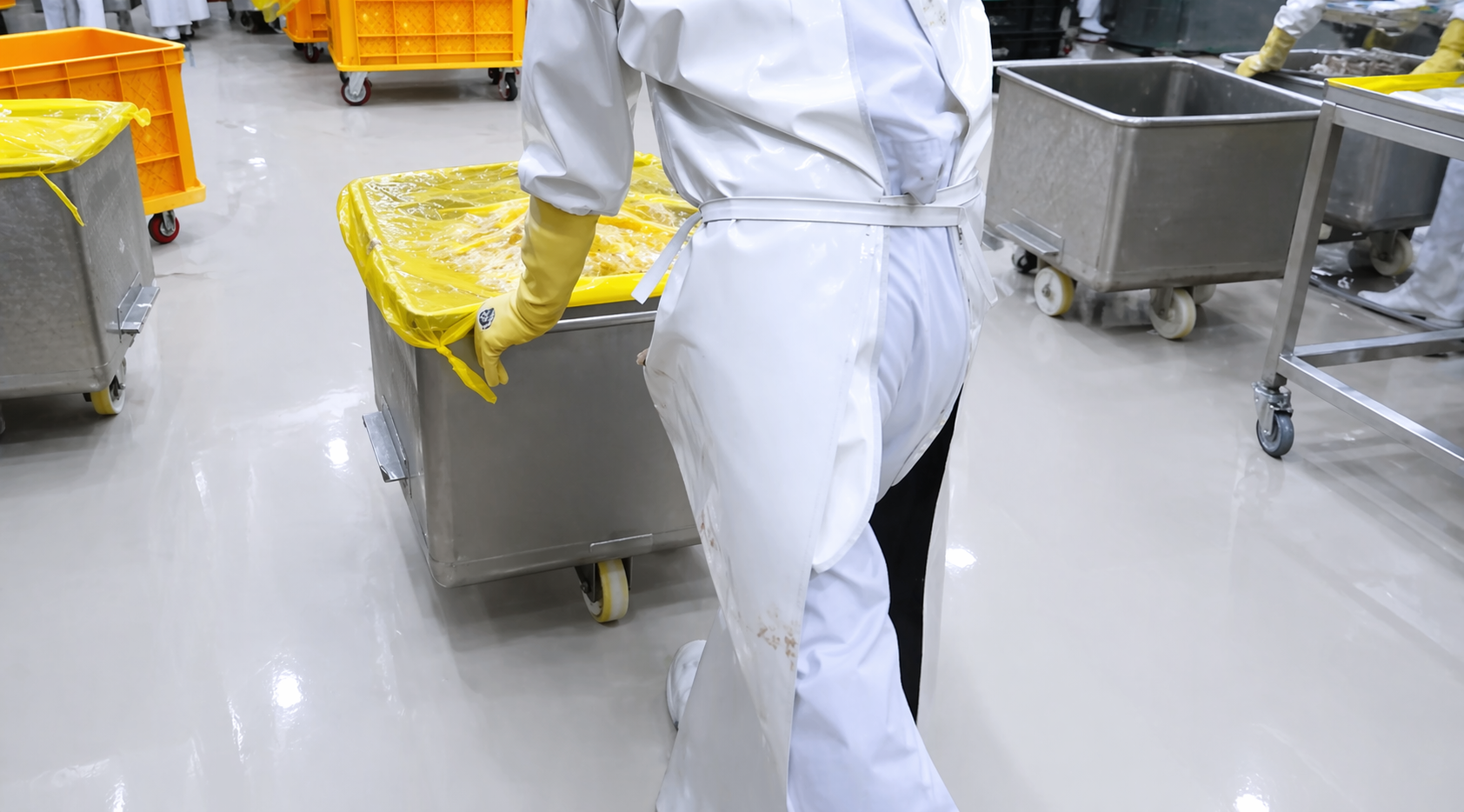
A mid-sized food processing facility specializing in packaged ready-to-eat meals operates multiple production lines daily. Ingredient bins and finished product racks move continuously between prep, cooking, cooling, and packaging zones.
Carts remain in near-constant motion during shifts and stay under load even when staged between processes. Mobility is not occasional—it is embedded into the production flow.
Business Challenge
Over a six-month period, the maintenance team began replacing casters on ingredient carts far more frequently than expected.
“We thought we chose a strong, durable wheel. Instead, we’re swapping casters constantly.”
Operators reported that carts no longer rolled smoothly after only a few weeks in service. Wheels appeared slightly flattened, and carts required noticeably more force to initiate movement at the start of a shift. Workflow speed slowed. Operator fatigue increased.
Nothing appeared overloaded. Nothing appeared structurally undersized. But performance declined steadily under normal operating conditions.
Existing Caster Configuration (Before)
Rig:
5x2
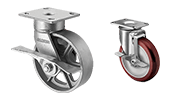
Kingpin & rigid combo
Zinc-plated steel
Wheel:
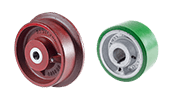
Phenolic resin
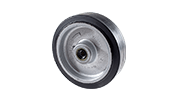
Flat
Roller
Observed Result:
Frequent wheel replacement due to flat spotting and increased rolling resistance under continuous daily use.
What Was Really Happening
This application was defined by continuous usage, not simply load capacity.
Ingredient carts operated throughout extended shifts and remained under sustained load during staging. That meant repeated cyclic deformation combined with prolonged static compression.
Three technical factors converged:
1. Rigid Tread Under Sustained Compression
Phenolic resin is strong and dimensionally stable under static load ratings. However, it lacks resilience under long-term cyclic deformation.
When held under load for extended periods, the material experienced compression set. It did not fully recover to its original geometry, leading to flat spotting.
2. Increased Rolling Resistance Over Time
Once flat spots developed, carts required greater start-up force. The issue was not bearing failure—it was geometric distortion in the wheel.
Operators felt the effect as resistance at the beginning of movement and vibration during travel.
3. Symptom Amplification Through the System
As rolling resistance increased, more force was transmitted through the bearing and rig assembly. While neither component caused the failure, both became part of the symptom chain once the wheel geometry degraded.
The root cause was material behavior under continuous duty.
Recommended Solution
The application required a wheel material capable of maintaining dimensional stability under sustained deformation and continuous cycling.
Rather than selecting for rigidity alone, the revised configuration prioritized creep resistance, long-term structural stability, and consistent rolling geometry under daily use.
Updated Caster Configuration
Rig:
5x2
Kingpinless & rigid combo
Stainless steel
Wheel:
White nylon
Crowned
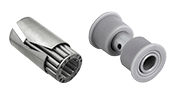
Pedestal ball
Why This Solution Worked
Improved Dimensional Stability Under Load
White nylon provides better long-term resistance to compression set in continuous-duty applications compared to rigid resin formulations. The wheel maintained its geometry despite sustained loading and repeated cycles.
Reduced Start-Up Resistance
By preventing flat spotting, the wheel preserved consistent rolling radius. Operators experienced smoother start-up and reduced push force at the beginning of shifts.
More Stable Tracking During Travel
The crowned wheel face reduced edge loading and minimized scrub during directional changes. This helped maintain predictable tracking and reduced vibration transmission through the system.
Balanced Bearing Performance
The pedestal ball bearing supported consistent rolling under medium-duty continuous use. With wheel geometry preserved, the bearing operated within stable load parameters rather than compensating for surface irregularities.
The solution addressed the system—not just a single component.
Results
- Significant reduction in flat spotting
- Extended caster service life
- Lower start-up push force at shift start
- Reduced maintenance interruptions
“We stopped thinking of it as a ‘tough wheel’ problem and started thinking of it as a continuous-duty system. That changed everything.”
Key Takeaway
Continuous-duty applications are defined by time under load, not just weight capacity. A wheel that performs well under static strength ratings may degrade when subjected to sustained deformation and cyclic stress.
Caster performance must be evaluated as an integrated system—wheel material stability, bearing consistency, and rig structure working together to maintain geometry and rolling efficiency over time.
How CasterDepot Can Help
For over 45 years, CasterDepot has helped food processing operations engineer mobility solutions that perform under real-world conditions—not just on spec sheets.
Next steps:
Talk it through with your local CasterHead®
Discuss pricing and lead time
Request supporting documentation
Test a sample in your application
Contact us now at https://www.casterdepot.com/contact/ or call one of our CasterHead® at 888.907.9952