













Company Overview
A regional commercial nursery supplies shrubs and potted trees to landscape contractors and retail garden centers. Large plant racks are moved daily between indoor growing zones and outdoor staging areas across compacted dirt, gravel lanes, and bark-covered concrete pads.
In this environment, mobility systems are exposed to continuous debris, uneven transitions, and repetitive impact loading throughout the workday.
Business Challenge
The nursery experienced repeated wheel failures on its outdoor transport racks.
“Within a few months, the wheels start chipping and the carts just don’t roll the same.”
Operators reported increasing push force, vibration when crossing gravel, and occasional jamming when debris became trapped beneath the wheel. Some wheels developed chipped edges and irregular rolling behavior, causing racks to drift or resist movement.
The issue was not load capacity. It was surface durability in a debris-dominated environment.
Existing Caster Configuration (Before)
Rig:
5 x 2"
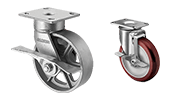
Kingpin & rigid combo
Zinc-plated steel
Wheel:
Phenolic resin
Flat
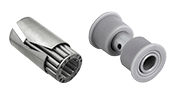
Roller
Observed Result:
Surface chipping, increased push force, vibration across gravel, and debris-related jamming.
What Was Really Happening
In heavy debris environments, wheel face geometry (35%) and tread material (30%) are primary performance drivers.
The phenolic resin wheel was extremely hard and dimensionally stable—but that hardness became a liability on gravel and bark-covered concrete. Loose debris created repeated point-loading and impact events. Because phenolic resin has limited shock absorption, impact energy was not dissipated—it was concentrated at the surface.
The flat tread profile compounded the problem. A flat face increases sustained full-width contact. In a debris-heavy environment, that allows gravel and bark to remain under load longer instead of shedding. Impact stresses became concentrated along the leading edges of the tread.
Over time, micro-fractures formed. Those fractures progressed into visible edge chipping. Once surface integrity was compromised, rolling resistance increased, vibration intensified, and steering consistency degraded.
The roller bearing was not the origin of failure. However, as the tread surface deteriorated, shock loading increased. That vibration transferred directly into the bearing system, accelerating rotational resistance and making carts feel increasingly unstable.
The rig structure remained intact. But with limited compliance in the wheel material and geometry, debris-induced impact energy had nowhere to dissipate.
The system did not fail from overload. It failed from impact concentration and material mismatch.
Recommended Solution
After reviewing the travel surfaces, debris conditions, and continuous outdoor use patterns, a revised configuration prioritized debris shedding, impact tolerance, and structural energy distribution across the wheel system.
Updated Caster Configuration
Rig:
5 x 2"
Kingpin & rigid combo
Zinc-plated steel
Wheel:
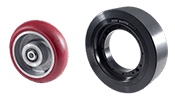
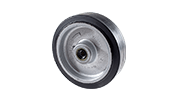
Polyurethane on aluminum
Round
Precision
Why This Solution Worked
Improved Debris Impact Resistance
Polyurethane provides significantly greater resistance to cutting, gouging, and repeated impact compared to phenolic resin. Instead of fracturing under point loading, the tread deforms elastically and distributes stress over a broader area. This reduces surface chipping and edge breakdown when traversing gravel and bark.
Debris Shedding Through Face Geometry
The round tread profile reduces sustained debris contact. Instead of trapping gravel beneath a wide flat footprint, the curved face allows particles to shed more readily as the wheel rolls forward. This limits stress concentration and reduces jamming events.
Structural Stability Through Aluminum Core
The aluminum hub maintains dimensional integrity under load while allowing the polyurethane tread to manage surface-level energy absorption. This balance prevents excessive flex while avoiding brittle fracture behavior.
More Controlled Rotation Under Shock Load
The precision bearing reduces rolling resistance and maintains smoother rotation as environmental vibration increases. By stabilizing rotational behavior, it prevents debris-induced vibration from compounding steering instability.
Together, the tread material, face geometry, and bearing system functioned as a coordinated mobility platform rather than isolated components.
Results
- Elimination of tread edge chipping in debris lanes
- Reduced push force when crossing gravel and bark
- Decreased vibration during outdoor rack transport
- Improved directional stability across uneven surfaces
“They’re holding up, even on the gravel runs. We’re not swapping wheels every season anymore.”
Key Takeaway
In heavy debris environments, wheel material and face geometry drive performance more than load rating alone. Hardness without impact tolerance accelerates surface failure when gravel and bark are constantly present.
Durable mobility in these conditions requires balanced energy management across tread, hub, rig, and bearing. When each component is selected to manage impact and debris interaction as a system, surface failure and handling instability are dramatically reduced.
How CasterDepot Can Help
For over 45 years, CasterDepot has helped Nursery & Greenhouse operations engineer mobility solutions that perform under real-world conditions—not just on spec sheets.
Next steps:
Talk it through with your local CasterHead®
Discuss pricing and lead time
Request supporting documentation
Test a sample in your application
Contact us now at https://www.casterdepot.com/contact/ or call one of our CasterHead® at 888.907.9952