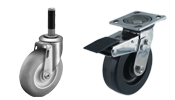













Company Overview
A mid-sized event production company manages touring audio and visual equipment for concerts and corporate events. Their road cases are routinely transported across stages, loading docks, and convention floors—often encountering transitions, seams, and mixed flooring conditions.
In these environments, equipment protection depends not only on case construction, but on how movement-induced forces are managed during transport.
Business Challenge
The company began experiencing increased vibration-related wear on sensitive equipment during transport.
"Equipment was arriving needing recalibration far more often than expected, even though nothing was being dropped or mishandled."
Crews also reported that carts felt harsh and unstable, particularly when crossing cables, seams, and surface transitions.
The issue was not structural failure. It was uncontrolled energy transfer during movement.
Existing Caster Configuration (Before)
Rig:
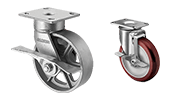
4x2"
Kingpin swivel
Zinc-plated steel
Wheel:
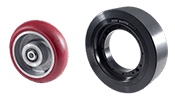
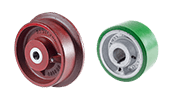
Phenolic resin
Flat
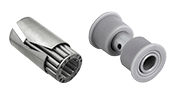
Roller
Observed Result:
The selected wheel material and geometry transmitted impact and vibration directly into the equipment, resulting in increased wear and harsh handling characteristics.
What Was Really Happening
A closer evaluation of the system revealed that the issue was not caused by a single component, but by how the wheel, rig, and bearing interacted under real-world conditions.
1. Rigid Wheel Material Transmitting Impact Energy
Phenolic resin wheels are designed for strength and dimensional stability under load. However, their rigidity prevents meaningful absorption of impact energy.
As cases crossed seams and uneven surfaces, forces were transferred directly through the wheel into the frame and contents, rather than being dissipated at the floor interface.
2. Flat Wheel Face Amplifying Surface Transitions
The flat tread profile increased the abruptness of contact with floor irregularities.
Instead of gradually rolling over transitions, the wheel encountered edges more directly, contributing to sharper impact events and increased vibration input into the system.
3. Bearing Efficiency Without Energy Isolation
Roller bearings supported load and enabled efficient rolling, but did not contribute to vibration reduction.
This allowed impacts generated at the floor interface to pass continuously through the wheel assembly without interruption, reinforcing the harsh ride characteristics reported by operators.
Recommended Solution
Based on actual operating conditions—including mixed flooring, frequent transitions, and the sensitivity of transported equipment—a revised configuration was selected to introduce controlled energy absorption and smoother interaction with surfaces.
Updated Caster Configuration
Rig:
4x2"
Kingpin swivel
Zinc-plated steel
Wheel:
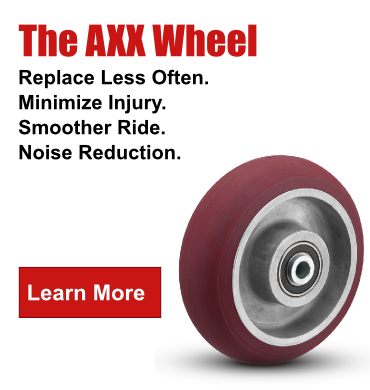
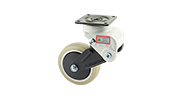
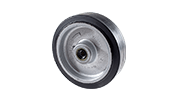
Polyurethane on aluminum
Round
Precision
Why This Solution Worked
Improved Energy Absorption at the Tread Level
Polyurethane introduced a controlled level of compliance at the floor interface, allowing the wheel to absorb and dissipate impact forces rather than transmitting them directly into the equipment.
This reduced the intensity of vibration entering the system during movement across uneven surfaces.
Smoother Surface Transitions with Round Wheel Profile
The round tread geometry allowed the wheel to roll more gradually over seams, cables, and transitions.
This reduced impact severity and minimized sudden force spikes that previously contributed to vibration transfer.
Reduced Rolling Resistance with Controlled Motion
Precision bearings improved rolling consistency and reduced internal friction.
While not a damping mechanism on their own, they enabled smoother, more predictable motion—reducing secondary vibration caused by inconsistent rolling behavior.
Balanced Structural Support from Aluminum Core
The aluminum core maintained structural integrity under load while allowing the polyurethane tread to perform its damping function effectively.
This balance prevented excessive deformation while still enabling meaningful vibration reduction.
Results
- Reduced vibration transfer into sensitive equipment during transport
- Decrease in recalibration and service frequency
- Smoother, more stable movement across mixed flooring conditions
- Improved operator control when navigating transitions and obstacles
"We immediately noticed the difference—less shake, less noise, and far fewer issues with equipment drift."
Key Takeaway
Effective vibration control in caster systems is not driven by a single component, but by how tread material, wheel geometry, and bearing behavior work together to manage energy transfer.
Rigid systems may perform well under load, but without controlled compliance and smooth rolling dynamics, they can introduce unwanted forces into sensitive applications.
How CasterDepot Can Help
For over 45 years, CasterDepot has helped road-case operations engineer mobility solutions that perform under real-world conditions—not just on spec sheets.
Next steps:
Talk it through with your local CasterHead®
Discuss pricing and lead time
Request supporting documentation
Test a sample in your application
Contact us now at https://www.casterdepot.com/contact/ or call one of our CasterHead® at 888.907.9952