












Company Overview
A mid-sized boat manufacturing company produces custom fiberglass hulls and marine assemblies. On the production floor, medium-duty carts transport structural components between welding stations, curing zones, and sub-assembly areas.
Certain fabrication zones experience sustained elevated ambient temperatures during active welding and curing cycles. While carts do not operate inside ovens or direct flame exposure, they remain in heat-affected areas long enough for thermal buildup to influence component performance.
Business Challenge
Carts operating near high-heat fabrication zones began requiring noticeably greater push effort after repeated exposure cycles. Operators reported that mobility felt progressively heavier and less predictable following time spent in elevated ambient conditions.
"We stayed within the load rating, but the carts just kept getting harder to move after being near the heat."
The issue was not structural failure. It was a gradual degradation of rolling performance tied specifically to thermal exposure. Carts functioned normally in cooler areas of the facility. The mobility issue consistently appeared only after extended time near welding and curing processes.
Existing Caster Configuration (Before)
Rig:
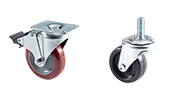
5x2"
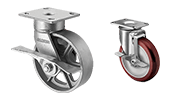
Kingpin & rigid combo
Zinc-plated steel
Wheel:
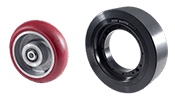
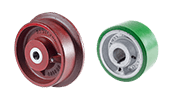
Phenolic resin
Flat
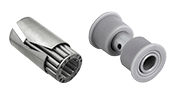
Roller
Observed Result:
Increased rolling resistance and visible surface degradation after repeated exposure to elevated ambient temperatures.
What Was Really Happening
The failure mechanism was material-driven and temperature-dominant.
Phenolic resin wheels are rigid and dimensionally stable under moderate heat, but high-heat applications prioritize temperature capability as the primary performance variable. In this environment, repeated exposure to elevated ambient heat gradually shifted the wheel material outside its optimal operating range.
As temperature increased, hardness banding changed. The wheel no longer deformed in a controlled manner at the floor interface. Instead, rolling resistance increased as contact stresses concentrated under load.
The flat face geometry further amplified this effect. A flat profile distributes load broadly under normal conditions, but when hardness shifts thermally, the same geometry can increase scrub resistance and reduce roll efficiency.
The roller bearing remained structurally sound and appropriate for the load. However, bearings cannot compensate for a tread material whose thermal properties have drifted outside its designed operating envelope.
The rig structure also remained intact. The kingpin design was not the source of failure.
The mobility system imbalance originated at the wheel material level, where temperature capability was insufficient for sustained ambient heat exposure.
Recommended Solution
To stabilize performance under elevated ambient heat, the wheel material needed to prioritize temperature capability above general durability.
A material inherently optimized for sustained high-temperature exposure was required to maintain hardness stability, structural integrity, and predictable rolling resistance across repeated thermal cycles.
Updated Caster Configuration
Rig:
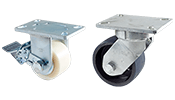
5x2"
Kingpinless & rigid combo
Zinc-plated steel
Wheel:
Cast iron
Flat
Roller
Why This Solution Worked
Thermal Stability Under Sustained Heat
Cast iron wheels provide significantly higher temperature capability compared to phenolic resin. Their structural properties remain stable under elevated ambient conditions typical of welding and curing zones.
This stability prevents hardness drift and maintains consistent rolling behavior across repeated heat cycles.
Preserved Hardness Banding and Load Behavior
Because the material’s mechanical properties remain stable at temperature, contact deformation remains predictable. Rolling resistance does not increase progressively with thermal exposure.
The flat face geometry continues to provide stable floor contact without amplifying thermally induced resistance.
Bearing and Rig System Balance
The roller bearing remains appropriate for medium-duty loads and sustained use. With a thermally stable wheel material, the bearing can perform as intended without compensating for altered tread behavior.
The kingpinless & rigid combo rig improves structural distribution of forces under load while maintaining maneuverability, ensuring that swivel performance remains consistent even as carts transition between hot and cooler zones.
The solution restores balance across wheel, bearing, and rig rather than attempting to correct a material limitation with structural changes alone.
Results
- Rolling resistance remained stable after repeated exposure to elevated ambient heat
- Elimination of visible surface degradation related to thermal stress
- Reduced push effort in fabrication zones
- Extended service life compared to the previous configuration
"The carts feel the same whether they’ve been near the weld stations or not. That consistency matters."
Key Takeaway
In high-heat applications, temperature capability is not a secondary specification—it is the controlling variable. Load rating alone does not ensure performance stability when ambient heat alters material behavior over time.
Caster systems must be evaluated as integrated assemblies. When wheel material thermal limits are exceeded, neither bearing upgrades nor structural rig changes can restore predictable mobility. Material selection must align with environmental temperature before optimizing other system components.
How CasterDepot Can Help
For over 45 years, CasterDepot has helped boat manufacturing operations engineer mobility solutions that perform under real-world conditions—not just on spec sheets.
Next steps:
Talk it through with your local CasterHead®
Discuss pricing and lead time
Request supporting documentation
Test a sample in your application
Contact us now at https://www.casterdepot.com/contact/ or call one of our CasterHead® at 888.907.9952