










Company Overview
A regional food processing facility produces baked and prepared hot-food products for national grocery distribution. Their operation relies on mobile oven racks that move directly from high-temperature ovens into staging and cooling zones multiple times per shift.
The racks remain in close proximity to elevated ambient heat during production runs.
Business Challenge
Over several production cycles, the facility began experiencing repeated caster issues on their oven racks. While load ratings were not being exceeded, operators noticed that racks became increasingly difficult to maneuver after extended use near ovens.
Maintenance teams reported that wheels would begin to lose shape and roll inconsistently after repeated exposure to elevated temperatures. Rolling resistance increased, and racks no longer tracked smoothly when transporting hot loads.
Production downtime increased due to frequent wheel replacements, and supervisors raised safety concerns about rack stability during movement.
“We weren’t overloading the racks. But after a few heat cycles, they just didn’t roll the same.”
Nothing had structurally failed. But performance was degrading in ways that affected safety, uptime, and operator control.
Existing Caster Configuration (Before)
Rig:
5x2"
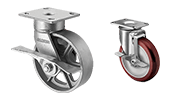
Kingpin & rigid combo
Zinc-plated steel
Wheel:
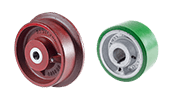
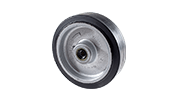
TPR on polypropylene
Flat
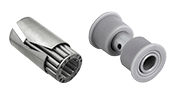
Roller
Observed Result:
Wheels softened and deformed under sustained elevated temperatures, increasing rolling resistance and reducing tracking stability.
What Was Really Happening
The original configuration met medium-duty load requirements and provided comfortable rolling on finished concrete floors. However, the application environment introduced a dominant performance variable: sustained elevated ambient heat.
Three system-level issues emerged over time.
1. Tread Softening Under Elevated Temperatures
The TPR tread material was selected for smooth, ergonomic movement. However, high-heat applications prioritize temperature capability and material stability under thermal exposure.
Repeated heat cycles reduced hardness retention and increased susceptibility to deformation. Under load, the tread began to flatten and lose dimensional stability.
This directly increased rolling resistance and altered contact behavior at the floor interface.
2. Dimensional Instability Affecting Tracking
As the tread deformed, the wheel no longer maintained consistent geometry. Instead of tracking predictably, racks began to resist directional changes and required increased operator correction.
What felt like “bearing drag” was actually tread instability influencing the entire mobility system.
3. Downstream Bearing Stress
The roller bearing was structurally sufficient under normal conditions. But once tread deformation altered load distribution, internal stresses increased.
The bearing did not initiate failure. It was reacting to inconsistent load transfer caused by thermally compromised wheel material.
The issue was not duty rating. It was temperature capability relative to sustained environmental exposure.
Recommended Solution
The revised configuration prioritized high-temperature material stability as the primary selection criterion, followed by structural consistency and predictable tracking.
Rather than optimizing for operator comfort near ambient conditions, the solution focused on maintaining dimensional integrity during repeated exposure to oven-adjacent heat.
Updated Caster Configuration
Rig:
5x2"
Kingpinless & rigid combo
Stainless steel
Wheel:
High-temp nylon
Crowned
Bronze
Why This Solution Worked
Material Stability Under Heat
High-temp nylon is engineered to retain mechanical properties at elevated operating temperatures. Instead of softening under repeated heat cycles, the tread maintains dimensional integrity under load.
This prevented the deformation that previously increased rolling resistance and compromised tracking.
Improved Structural Consistency
By eliminating thermally induced tread distortion, load transfer through the wheel remained consistent. The crowned face further supported controlled contact and reduced edge loading as racks transitioned between oven and cooling areas.
Movement returned to predictable, stable behavior.
Bearing Performance Aligned to Environment
The bronze bearing provided temperature-tolerant rotational support without reliance on elements that can degrade under elevated heat exposure.
With tread stability restored, the bearing operated under consistent load distribution, maintaining rolling efficiency over repeated production cycles.
Rig Upgrade for Environmental Compatibility
The stainless steel kingpinless & rigid combo improved structural durability in a thermally aggressive, food-processing environment. While the rig was not the initial failure point, its upgrade ensured long-term corrosion resistance and structural consistency near ovens.
The system now operated as an integrated mobility solution rather than a collection of individually rated components.
Results
- Rolling resistance remained stable across repeated heat cycles
- Reduced frequency of wheel replacement
- Improved rack tracking and maneuverability near ovens
- Decreased production downtime linked to caster changeouts
“We stopped replacing wheels every few weeks. The racks roll the same at the end of the shift as they do at the start.”
Key Takeaway
In high-heat food processing environments, temperature capability must anchor the entire caster selection process. Load rating alone cannot predict real-world performance when sustained thermal exposure alters material behavior.
Caster systems perform as integrated assemblies. Wheel material stability, bearing compatibility, and rig durability must align with environmental conditions to prevent gradual performance degradation that affects safety and uptime.
How CasterDepot Can Help
For over 45 years, CasterDepot has helped food processing operations engineer mobility solutions that perform under real-world conditions—not just on spec sheets.
Next steps:
Talk it through with your local CasterHead®
Discuss pricing and lead time
Request supporting documentation
Test a sample in your application
Contact us now at https://www.casterdepot.com/contact/ or call one of our CasterHead® at 888.907.9952