










Company Overview
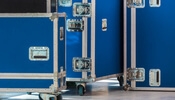
A mid-sized production company specializing in live event staging and touring support. Their equipment is frequently transported between venues, requiring constant loading, unloading, and repositioning of heavy road cases.
Business Challenge
The crew began reporting increasing physical strain during routine transport. Tasks that were once manageable now required noticeably more effort, particularly during long load-in and load-out days.
"By the end of the day, it felt like we were fighting the cases more than moving them."
Fatigue began setting in earlier, slowing operations and increasing frustration across crews working repeated shifts in varied venue environments.
Existing Caster Configuration (Before)
Rig:
4x2"
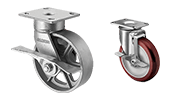
Kingpin swivel
Zinc-plated steel
Wheel:
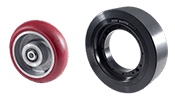
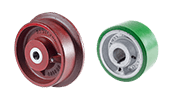
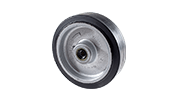
Rubber on cast iron
Crowned
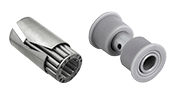
Roller
Observed Result:
The configuration maintained durability but introduced increasing rolling resistance and operator fatigue during extended manual transport.
What Was Really Happening
A closer evaluation of the system revealed that the issue was not load capacity or structural failure—it was energy loss throughout the mobility system.
1. Energy Absorption in the Wheel Material
The rubber tread absorbed energy under load instead of returning it efficiently. While this provided some vibration reduction, it required continuous input force from operators to maintain motion.
Over long distances, this translated directly into higher push and pull effort.
2. Resistance Introduced by the Rig Design
The kingpin swivel design added friction during directional changes, particularly under continuous movement. This created additional resistance when initiating turns and maintaining tracking, increasing cumulative effort during repeated cycles.
3. Bearing Inefficiency Under Manual Movement
Roller bearings supported load but did not minimize rolling resistance in start-stop, manually driven conditions.
Operators experienced higher startup force requirements and less consistent rolling behavior, further compounding fatigue when combined with the energy-absorbing tread.
Recommended Solution
The revised configuration focused on reducing energy loss across the entire system—improving how force is transferred, maintained, and returned during movement rather than absorbed.
Updated Caster Configuration
Rig:
4x2"
Kingpin swivel
Zinc-plated steel
Wheel:
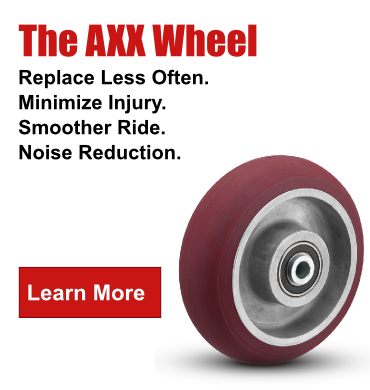
Polyurethane on polypropylene
Crowned
Pedestal ball
Why This Solution Worked
Improved Energy Return at the Wheel Level
Polyurethane provided higher resilience compared to rubber, reducing deformation losses during rolling. Instead of absorbing input energy, the wheel returned more of it into forward motion, lowering sustained push force.
Reduced Rolling Resistance Through Bearing Selection
The pedestal ball bearing minimized friction during both startup and continuous movement. This improved rolling consistency and reduced the effort required to initiate motion under load.
Balanced Maneuverability Without Excess Loss
Maintaining the crowned profile preserved maneuverability, while the improved wheel and bearing combination prevented the system from losing energy during direction changes.
System-Level Efficiency Gains
Rather than relying on a single component, the updated configuration reduced cumulative resistance across the wheel, bearing, and rig interaction—resulting in smoother, more predictable movement.
Results
- Reduced push and pull effort during transport
- Delayed onset of operator fatigue during long shifts
- More consistent rolling behavior across varied surfaces
- Improved crew efficiency during load-in and load-out
"It’s not just easier—it stays easier throughout the whole day."
Key Takeaway
Operator fatigue in manual transport is rarely caused by a single component. It is the result of cumulative energy losses across the wheel, bearing, and rig working together under real-world conditions.
Improving ergonomic performance requires reducing those losses system-wide—ensuring that input force translates into motion efficiently, rather than being absorbed or resisted at multiple points.
How CasterDepot Can Help
For over 45 years, CasterDepot has helped road-case operations engineer mobility solutions that perform under real-world conditions—not just on spec sheets.
Next steps:
Talk it through with your local CasterHead®
Discuss pricing and lead time
Request supporting documentation
Test a sample in your application
Contact us now at https://www.casterdepot.com/contact/ or call one of our CasterHead® at 888.907.9952