













People tend to throw around terms with reckless abandon.
Adenosine triphosphate. Allotropy. Hippopotomonstrosesquippedaliophobia. Load capacity.
Sometimes it’s nice to know what one of them means.
Load Capacity
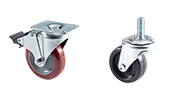
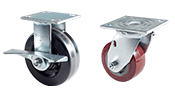
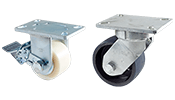
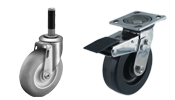
Simply put, a caster’s load capacity (sometimes referred to as its weight capacity) is the maximum amount of weight a caster or wheel will safely hold.
And for the most part, there are three different ways to measure load capacity:

IMPACT LOAD
The temporary load that is exerted on the wheel or caster by shock or vibration.

STATIC LOAD
The load that is imposed when the wheel or caster is stationary

DYNAMIC LOAD
The load that is imposed when the wheel or caster is in motion.
But, here in the caster stratosphere, when talking about load capacity, we’re almost always referring to dynamic load capacity.
Some useful info when researching or purchasing wheels or casters.
A wheel or caster’s load capacity refers to the amount of weight each wheel or caster can support. It is not referring to the total load capacity of the truck, trailer or cart. For example, if you purchase four casters for a cart that have load capacities of 500 lbs each, the total load capacity for the cart is 2000 lbs. Pretty straightforward, right?
And remember the impact load we mentioned earlier? Because of that and other factors, when figuring out how much load capacity is needed for an application, it is important to build in a safety net.
The following equation is a good rule of thumb.