












 Both in the office and on the production floor, ergonomics affect employee performance and the overall productivity of small and large companies. When a worker is equipped for safety, efficiency, and ease of motion on the job, both satisfaction and productivity are known to increase. Surprisingly, casters and wheels play a significant role in terms of ergonomics for both office and industrial workers.
Consider that wheels are one of the most commonly used components in nearly every industry including aviation, medical, military, high-tech and manufacturing environments. Superior wheel construction for ergonomically sound environments involves durable, high-end casters—the housings that include wheels and precision parts and materials to support thousands of unique applications.
When you have employees involved in physical activities as part of their job duties, proper ergonomics are critical to workplace safety. Whether employees are lifting, maneuvering, pushing, pulling, loading and unloading, riding, driving, or simply rolling back and forth in an office chair, you have serious repetition of motion that affects your employees over the short and long term. The fact is, the construction of casters found on nearly every office and industrial component is key when it comes to positive employee ergonomics.
Let’s take a look at the magnitude of the best-kept secret in ergonomics for your office and industrial equipment.
The Role of a Caster
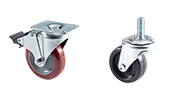
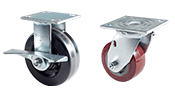
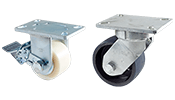
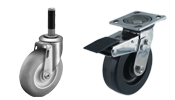
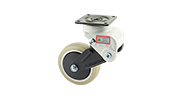
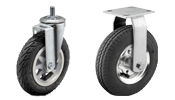
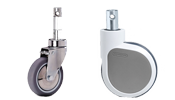
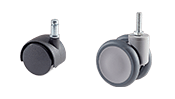
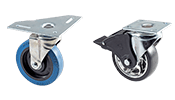
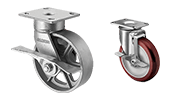
Casters are made in two different styles: swivel and rigid. A swivel caster is able to rotate and allow movement in any desired direction. A rigid caster is restricted to rolling in a single direction. With a variety of caster models available for each style, selecting the correct caster for an application is an important choice. In making a caster selection based on comfort and safety in the workplace, consider the following questions:
- Is the load is easy to begin moving from a stationary position? The force needed initiate movement should be minimal and a larger wheel diameter will decrease the force needed to initiate movement
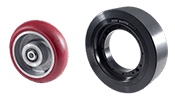
- Does the load rolls seamlessly from one position to another? The force needed to maintain the load's current movement should be minimal. A wheel's material and durometer will affect this.
- Can the load be easily redirected? All swivel casters should allow a load to change directions with minimal or no resistance. Wheels with a rounded tread
- Can the casters support the weight of the load? The sum of your casters' dynamic capacities should not exceed the potential load weight.
- Are you using the right bearing for your application? Varying grades of wheel bearings affect the resistance level and rolling friction of your casters.
Casters are a seemingly simple product, but can get pretty technical. But, fret not! CasterDepot's trained professionals can help you find the best ergonomic mobility solution for you.
The Benefits of Ergonomic Casters
There are a number of valuable ergonomic benefits hidden in this small but significant component of your office or industrial environment. The intricate construction and high-quality materials in superior casters is certain to make a difference both in the office and on the production floor. High-end swivel and rigid casters are a key component to these ergonomic benefits:
- Safety in the workplace
- Comfort of your employees
- A cost conscious effort in the long run
- Improved productivity
- Reduced exertion
- Reduced workplace injury
Casters have a major impact on operations in every industry. When you invest in the right casters for your unique environment, you invest in your health and the health of your workers. Whatever you application may be, CasterDepot can provide the expertise and products to find your ideal ergonomic solution.