
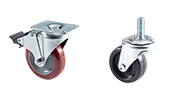
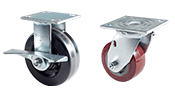
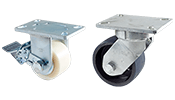
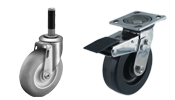
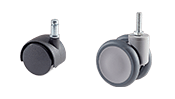
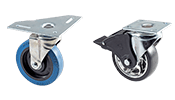
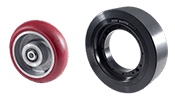
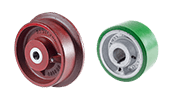













Early wheels used for everything from hand carts to furniture were generally made from Bakelite, a current-day, sought-after collectible material when it comes to vintage dressing table accessories and old tube-style radios. The durability properties of Bakelite live on in phenolic resin, a beneficial and worthy descendant for today’s casters and wheels.
Consider the following reasons why phenolic casters and wheels may be the best solution for your industrial or technical application.
- Low Cost. For a budget-based solution, phenolic casters and wheels are often the best option. While phenolic material may not have the longevity factor seen in some other more modern materials, the price point is attractive.
- Made in the USA. CasterDepot's phenolic wheels are manufactured right here in the United States. Our domestic product ensures you receive a high quality phenolic wheel every time. The phenolic wheels that imported from China that are not necessarily true phenolics because corners are cut: materials are substituted and the wheels are frequently not uniform in shape and tend to be cheaply made in general. These imitations have a much shorter lifespan than their domestic counterparts. You can tell a cheap imported phenolic wheel by its overly shiny finish.
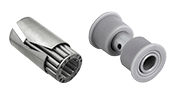
- Wide Bearing Selection. Phenolic casters can use a wide variety of bearings. CasterDepot has options that include the standard roller bearings, caged roller bearings, tapered roller bearings, Delrin® bearings, bronze bearings, sealed precision ball bearings, and pedestal precision bearings.
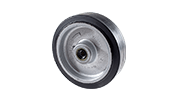
- Customizable. Phenolic wheels have diameters ranging from 3" to 18" and widths from 1-1/4" to 6", and weight capacities that reach up to 8,000 pounds per wheel. Phenolic wheels can also be custom made for various applications with features such as v-grooves, u-grooves, flanges and drive hubs. Fill out our Wheel Application Guide to help us find your ideal caster solution.
- Weight Bearing. Phenolic resin is molded and shaped for performance. Casters and wheels can be designed for strength based on the size and shape of wheel needed for heavy loads, up to 8,000 pounds per wheel. Phenolic casters and wheels are constructed of engineered plastic that is made to handle excessive weight and all the while provide stability and superior ergonomics. Expect wheels made from this product to roll with precision.
- Best for Industrial Environments and Tough Surfaces. This extremely tough material is suited for industrial environments where floor protection is not a serious concern. Despite being composed of a non-marking material, phenolic wheels do not necessarily protect the floors they're used on because phenolic resin can leave a slight trail on harder floors.
- Durable with Maximum Hardness. Macerated, or softened, denim is mixed with a hard resin to create a compound that is made to stand up to the elements. After high temperature and extreme pressure, the end results hold up in the toughest applications. Phenolic wheels have a 90 Shore D durometer. This means they are harder than golfballs, and as dense as bone.
- Used in Dry Locations, It Performs Well. While not designed for use in water, casters and wheels made from phenolic resin perform amazingly in dry locations. Avoid warpage by selecting this material primarily for dry locations. Also, a phenolic wheel's exposure to liquid should be limited! Due to the chemical structure of phenolic resin, a phenolic wheel acts as a sponge when chipped or cracked. The wheel will then become misshaped and useless. If exposure to liquid is a concern, we will gladly help you select a wheel material.
- Excellent in Clean Locations on Solid Concrete or Smooth and Durable Surfaces. Made for smooth and durables surfaces, phenolic casters and wheels perform best in clean environments that are free from debris, as long as some surface marking is acceptable. If debris is present, it can collect on the wheels and damage soft surfaces. Ask us about Colson thread guards and other options if debris is a concern!
- Lightweight and Efficient. The materials used in phenolic casters and wheels result in a product that is lightweight and efficient compared to its metal alternatives with similar dynamic capacities. When caster and wheel weight is a concern, this wheel is worth looking into.
- An Oil-Resistant Wheel. You can’t beat phenolic resin for oil resistance. This amazing material is used to resist elements such as oil and grease. Water and other liquids can break down phenolic wheels and tend to be harsher on them than oil and grease.
- Handles the heat. Standard phenolic wheels can handle continuous use in a temperature range that reaches 250ºF, but high temp (HT) phenolic wheels can used to for higher temperatures. HT phenolic wheels are able to intermittently operate at temperatures all the way up to 525ºF and continuously operate at temperature up to 475ºF
Selecting the best wheel material for your application is an important decision and one you want to make correctly. The right choice may save you time and money, and create a safer and more efficient environment for your workers and your company. Phenolic casters and wheels may be the cost-efficient solution you are seeking. Let CasterDepot's industry experts help you do your research, compare advantages and disadvantages, and make an educated decision to ensure your productivity levels stay as high as possible.